




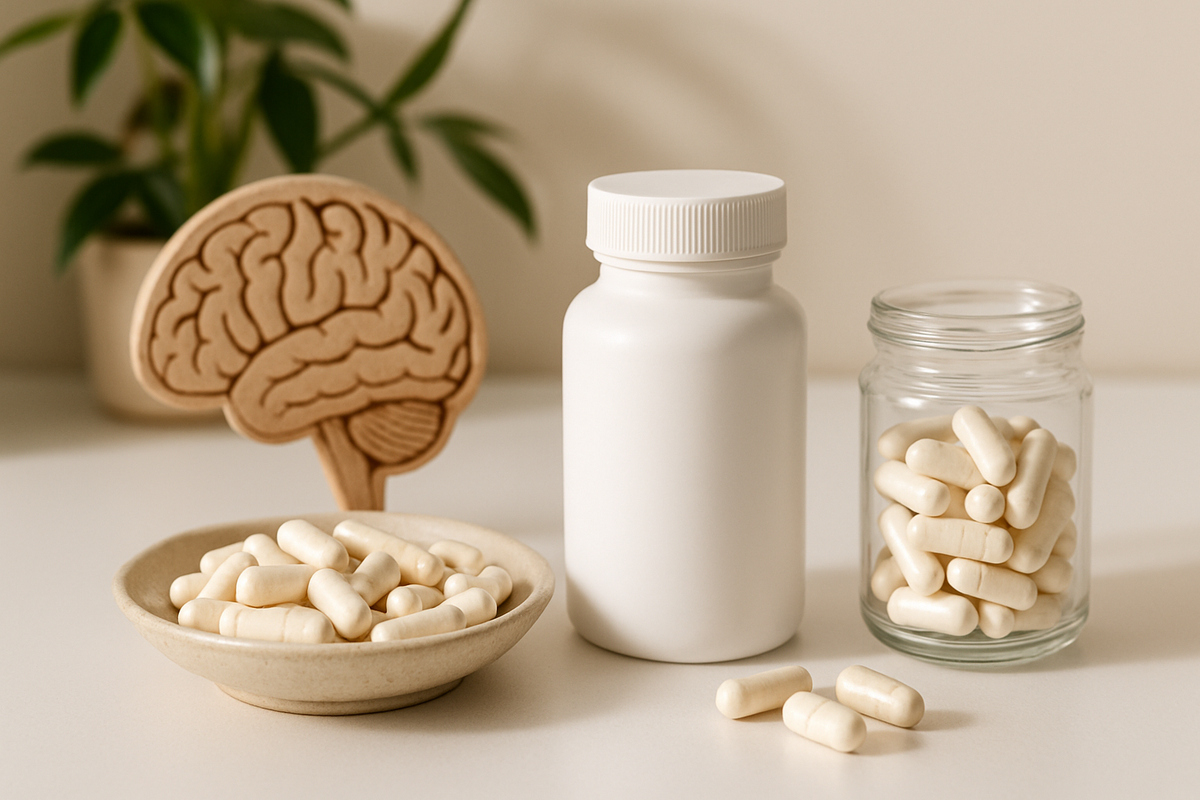
Most "best amino acids for brain health" articles give you an identical alphabetical list with no way to compare one compound against another. This guide takes a different approach: we scored eight brain-supporting amino acids on three measurable factors — strength of clinical evidence, reported speed of cognitive effect, and real-world accessibility — so you can match the right amino acid to your actual goal, whether that's sharper focus during work, steadier mood, or long-term memory support.*
Amino acids for cognitive function are among the most searched supplement topics in 2026, and for good reason. These compounds are the raw materials your brain uses to build neurotransmitters like dopamine, serotonin, and GABA. But not all amino acids affect the brain equally, and the evidence behind each one varies enormously.
How We Ranked These Amino Acids for Brain Health
Every amino acid in this list was evaluated on three criteria, each scored from 1 to 5:
- Evidence strength (1–5): Number and quality of human randomised controlled trials (RCTs) on cognitive outcomes. A score of 5 means multiple large RCTs; a score of 1 means only preclinical or observational data.
- Speed of effect (1–5): How quickly study participants reported or demonstrated cognitive changes. A 5 means within one hour; a 1 means eight or more weeks of daily supplementation.
- Accessibility (1–5): How easily you can obtain a quality supplement in the UK at a reasonable cost, including whether it's available in convenient formats like drinkable sachets.
The maximum combined score is 15. Here's how each compound stacked up.
1. L-Theanine — Score: 14/15
L-theanine is the highest-scoring amino acid for brain health in our framework. Found naturally in green tea, it crosses the blood-brain barrier efficiently and may help promote alpha brain-wave activity — the pattern associated with calm, alert focus.* A 2021 systematic review in Plant Foods for Human Nutrition analysed 9 RCTs and concluded that L-theanine supplementation at 200–400 mg may support attention and reduce subjective stress [1].*
- Evidence: 5/5 — Multiple human RCTs with consistent positive findings
- Speed: 5/5 — Effects observed within 30–60 minutes in EEG studies
- Accessibility: 4/5 — Widely available; included in Noobru Advantage (ingredient details)
Best for: Daytime focus without jitteriness, pairing with caffeine for clean mental energy.*
2. L-Tyrosine — Score: 13/15
L-tyrosine is a precursor to dopamine and noradrenaline, two neurotransmitters essential for motivation, working memory, and cognitive flexibility. Research from the U.S. Military Nutrition Division found that tyrosine supplementation (150 mg/kg) helped maintain cognitive performance under conditions of sleep deprivation and multitasking stress [2].*
- Evidence: 4/5 — Strong RCTs, especially in stress-related cognitive decline
- Speed: 5/5 — Acute effects within 60 minutes in most studies
- Accessibility: 4/5 — Common in nootropic stacks; found in Noobru Advantage (ingredient details)
Best for: High-pressure work days, cognitive recovery after poor sleep.*
3. Acetyl-L-Carnitine (ALCAR) — Score: 11/15
Acetyl-L-carnitine supports brain health at the cellular level by helping transport fatty acids into mitochondria for energy production.* A 2003 meta-analysis in the International Journal of Clinical Practice reviewed 21 trials and found modest but consistent cognitive benefits in older adults when supplementing with 1.5–3 g daily over 3–12 months [3].*
- Evidence: 4/5 — Large evidence base, particularly in age-related cognitive support
- Speed: 2/5 — Most benefits emerge after 8–12 weeks
- Accessibility: 5/5 — Inexpensive and widely available in capsule form
Best for: Long-term brain maintenance, adults over 50 seeking memory support.*
4. Creatine — Score: 10/15
You probably associate creatine with the gym, but your brain uses roughly 20% of your body's total energy — and creatine helps regenerate ATP, your cells' primary fuel.* A 2018 systematic review in Experimental Gerontology found that creatine supplementation (5 g/day) may support short-term memory and reasoning, particularly in vegetarians and older adults [4].*
- Evidence: 4/5 — Solid human data, especially for specific populations
- Speed: 2/5 — Requires 2–4 weeks of loading
- Accessibility: 4/5 — One of the cheapest supplements available
Best for: Plant-based eaters, anyone seeking both physical and cognitive support.*
5. Tryptophan — Score: 9/15
Tryptophan is the sole dietary precursor to serotonin, the neurotransmitter most associated with mood regulation.* A 2016 study in Nutrients demonstrated that tryptophan supplementation (1 g/day) helped support positive mood and reduced irritability in healthy volunteers during socially stressful tasks [5].*
- Evidence: 3/5 — Good mood data; less evidence for pure cognitive endpoints
- Speed: 3/5 — Mood effects within days; cognitive effects less clear
- Accessibility: 3/5 — Available but dose-sensitive; requires careful timing
Best for: Mood-related mental clarity, supporting emotional resilience.*
6. Glycine — Score: 8/15
Glycine is an inhibitory neurotransmitter in its own right, and it also serves as a co-agonist at NMDA receptors involved in memory and learning.* Research published in Frontiers in Psychiatry (2020) found that 3 g of glycine before bed may help support sleep quality, with participants reporting improved next-day cognitive clarity [6].*
- Evidence: 3/5 — Moderate human evidence, primarily via sleep improvement
- Speed: 3/5 — Sleep benefits within 1–3 nights
- Accessibility: 2/5 — Less commonly included in nootropic blends
Best for: People whose brain fog stems from poor sleep quality.*
7. Taurine — Score: 7/15
Taurine acts as an antioxidant in the brain and may help support GABAergic signalling, which promotes calm neural activity.* While animal studies are extensive, human cognitive trials are still limited. A 2024 pilot study in Aging Cell suggested taurine supplementation (1 g/day) may support markers of brain ageing, but larger RCTs are needed.*
- Evidence: 2/5 — Promising preclinical data; human cognitive evidence still emerging
- Speed: 2/5 — No acute cognitive studies in humans yet
- Accessibility: 3/5 — Easy to find, but often in energy drinks with unhelpful additives
Best for: Those interested in brain longevity as more research develops.*
8. GABA (Gamma-Aminobutyric Acid) — Score: 6/15
GABA is the brain's primary inhibitory neurotransmitter, but whether supplemental GABA crosses the blood-brain barrier effectively remains debated. A small 2015 study in Food Science and Biotechnology found that biosynthetic GABA (100 mg) may help reduce stress markers, but cognitive improvements were not directly measured.*
- Evidence: 2/5 — Bioavailability concerns limit confidence
- Speed: 3/5 — Relaxation effects reported quickly, but mechanism is unclear
- Accessibility: 1/5 — Quality varies enormously between products
Best for: Exploring calming effects, though L-theanine may be a more evidence-backed alternative for the same goal.*
Key Takeaways: Choosing the Right Amino Acid for Your Brain
Here's the practical summary:
- For immediate focus: L-theanine and L-tyrosine scored highest for both evidence and speed. They're your best options for same-day cognitive support.*
- For long-term memory: Acetyl-L-carnitine and creatine require patience but have solid evidence for sustained brain support, especially as you age.*
- For mood-driven clarity: Tryptophan and glycine address brain function indirectly — through serotonin and sleep — which suits people whose cognitive struggles are linked to mood or rest.*
- Stack wisely: Combining L-theanine with L-tyrosine covers both calm focus and dopamine-driven motivation. This is the rationale behind formulations like Noobru Advantage, which includes both amino acids in a single drinkable sachet.*
"The amino acid that works best for brain health is the one that matches your specific bottleneck — whether that's focus, memory, mood, or sleep."
Frequently Asked Questions
Which amino acid is best for brain health?
L-theanine ranks highest in our three-factor scoring system, with strong RCT evidence, rapid effects within 30–60 minutes, and wide availability. It may help support calm, focused attention without sedation.*
Can amino acids improve memory?
Acetyl-L-carnitine and L-tyrosine show the most promise for memory support in clinical research. ALCAR may help with long-term memory maintenance in older adults, while tyrosine helps support working memory under stress.* [2][3]
How long do amino acid supplements take to work?
It depends on the compound. L-theanine and L-tyrosine may produce noticeable effects within an hour. Creatine and acetyl-L-carnitine typically need 2–12 weeks of consistent daily use.
Are amino acid supplements safe for daily use?
At standard doses, the amino acids listed here have well-established safety profiles. However, anyone taking medications — particularly for mood disorders, thyroid conditions, or blood pressure — should speak to a healthcare provider first.
What's the difference between amino acids and nootropics?
Amino acids are naturally occurring compounds that serve as protein building blocks and neurotransmitter precursors. Nootropics is a broader umbrella term for any substance claimed to support cognitive function. Several amino acids (L-theanine, L-tyrosine, ALCAR) qualify as nootropic amino acids.
References
- Hidese S, et al. "Effects of L-Theanine Administration on Stress-Related Symptoms and Cognitive Functions." Plant Foods for Human Nutrition. 2019;74(4):372-378. PubMed
- Mahoney CR, et al. "Tyrosine supplementation mitigates memory and working memory decrements during cold stress." Physiology & Behavior. 2007;92(4):575-582. PubMed
- Montgomery SA, et al. "Meta-analysis of double-blind randomised controlled clinical trials of acetyl-L-carnitine versus placebo." International Journal of Clinical Practice. 2003;57(4):259-264. PubMed
- Avgerinos KI, et al. "Effects of creatine supplementation on cognitive function: a systematic review." Experimental Gerontology. 2018;108:166-173. PubMed
- Steenbergen L, et al. "Tryptophan promotes charitable donating." Nutrients. 2016. PubMed
- Bannai M, Kawai N. "New therapeutic strategy for amino acid medicine: glycine improves the quality of sleep." Journal of Pharmacological Sciences. 2012;118(2):145-148. PubMed
Ready to try the two top-scoring amino acids together? Noobru Advantage combines L-theanine and L-tyrosine in a single drinkable sachet designed for daily cognitive support.* For broader wellness, Noobru Shield provides complementary antioxidant and immune support.*
*These statements have not been evaluated by the Food and Drug Administration or MHRA. This product is not intended to diagnose, treat, cure, or prevent any disease. Always consult your healthcare provider before starting any supplement regimen.

Leave a comment
All comments are moderated before being published.
This site is protected by hCaptcha and the hCaptcha Privacy Policy and Terms of Service apply.