




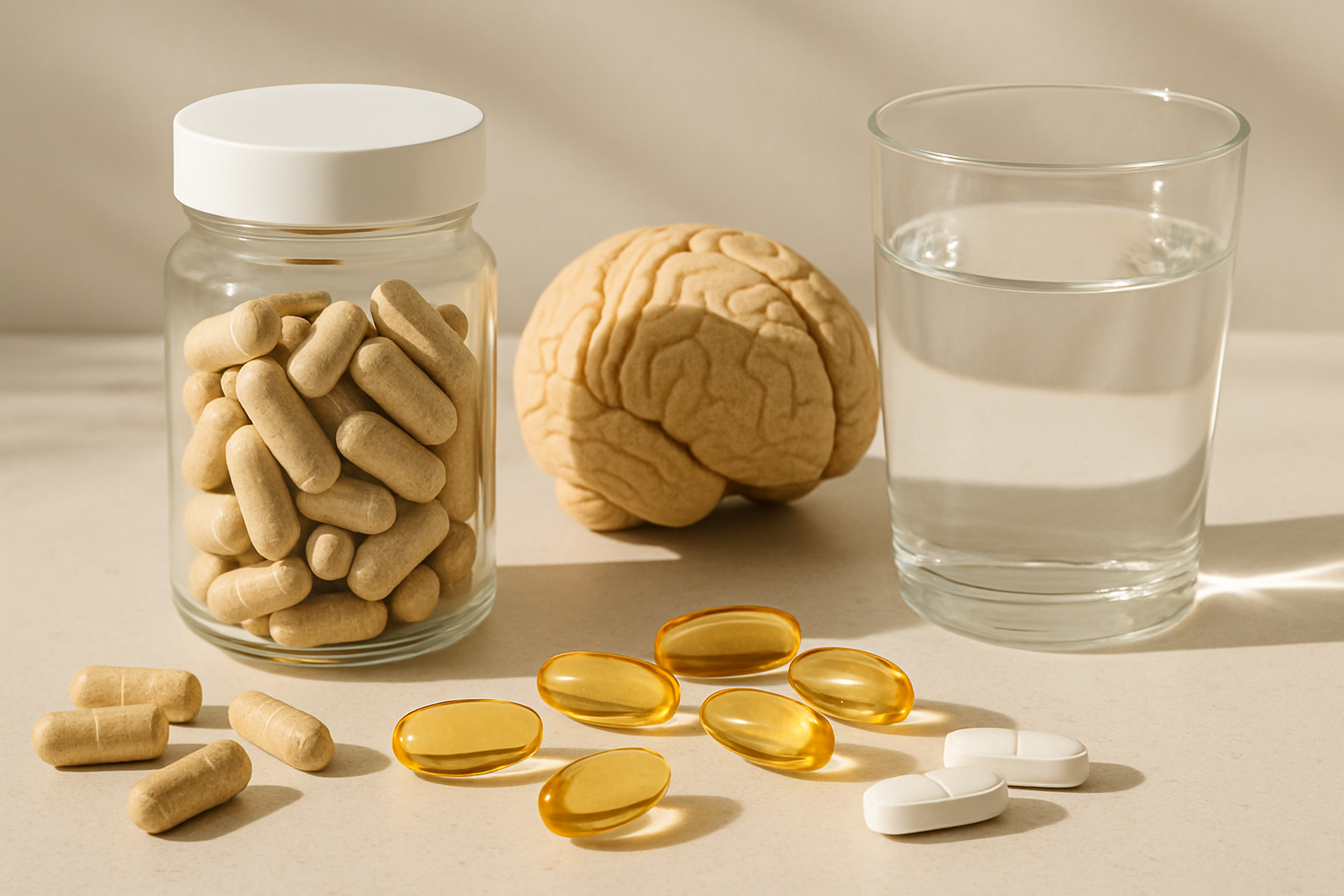
Brain health supplements are dietary products containing ingredients that may help support cognitive function, memory, focus, and long-term neurological wellbeing.* The global nootropics market is booming — but most products on the shelf don't deliver what they promise. This guide examines what the science actually says: the best-studied ingredients, their proper dosages, and exactly how to choose a brain health supplement worth your money.
Why Are Brain Health Supplements Growing So Fast in the UK?
Cognitive health is no longer a concern reserved for older adults. The Alzheimer's Society reports over 900,000 people in the UK living with dementia, with projections exceeding one million by 2025 [1].
But age-related decline isn't the only driver. Younger professionals and students increasingly seek evidence-based ways to stay sharp under pressure from back-to-back meetings, constant digital stimulation, and chronic stress.
Here's the uncomfortable truth: the supplement industry's marketing has outpaced its science. Proprietary blends hide real dosages. "Fairy dusting" — adding trace amounts of headline ingredients — is rampant. Understanding what works, at what dose, is the only way to make an informed choice.
What Are the 7 Most Evidence-Backed Brain Health Ingredients?
Not all nootropic ingredients are created equal. These seven have the strongest body of clinical evidence, listed with the dosages that actually produced results in peer-reviewed research.
1. How Does Bacopa Monnieri Support Memory?
Bacopa Monnieri is one of the most thoroughly studied natural nootropics. It enhances synaptic communication by modulating acetylcholine and serotonin pathways.*
Its active compounds — bacosides A and B — provide antioxidant protection to neurons. A 2014 meta-analysis in the Journal of Ethnopharmacology found significant improvements in memory free recall [2].
Clinical dose: 300–600mg daily, standardised to 55% bacosides.
Key caveat: Bacopa is slow-acting. Most studies show meaningful results after 8–12 weeks of consistent use.
2. What Does Citicoline (CDP Choline) Do for the Brain?
Citicoline provides two essential building blocks: choline (a precursor to acetylcholine, the "learning neurotransmitter") and cytidine (which converts to uridine, supporting synaptic plasticity and membrane repair).*
A 2015 study demonstrated improved attention and psychomotor speed, with increased frontal lobe bioenergetics visible on MRI [3].
Clinical dose: 250–500mg daily.
3. Can Lion's Mane Mushroom Improve Cognitive Function?
Lion's Mane stimulates production of Nerve Growth Factor (NGF) and Brain-Derived Neurotrophic Factor (BDNF), two proteins critical for neurogenesis and myelin repair.*
A 2009 double-blind trial in adults with mild cognitive impairment found significant improvements in cognitive function scores versus placebo [4].
Clinical dose: 500–1000mg daily.
Quality note: Insist on fruiting body extracts. Mycelium grown on grain is substantially less potent.
4. Why Is L-Theanine So Effective with Caffeine?
L-Theanine promotes alpha brain wave activity — the frequency associated with calm, focused alertness.* It modulates GABA, serotonin, and dopamine simultaneously.
A 2008 study in Nutritional Neuroscience showed the L-Theanine/caffeine combination improved both speed and accuracy of attention tasks beyond what either compound achieved alone [5].
Clinical dose: 100–200mg L-Theanine, often paired with 50–100mg caffeine.
5. How Does Rhodiola Rosea Reduce Mental Fatigue?
Rhodiola Rosea acts on the HPA axis to regulate cortisol and adrenaline while increasing serotonin and dopamine availability.* It's the closest thing to a "stress buffer" in the nootropics world.
A landmark 2000 study found significant reductions in mental fatigue alongside improvements in associative thinking, short-term memory, and calculation speed [6].
Clinical dose: 200–600mg daily, standardised to 3% rosavins and 1% salidroside.
6. Why Is Vitamin B12 Critical for Brain Health?
Vitamin B12 (methylcobalamin) is essential for myelin sheath synthesis, DNA repair, and red blood cell formation. It's the nutrient most commonly deficient in adults over 50.
A 2016 study found low B12 levels were strongly associated with accelerated brain volume loss and cognitive decline [7].
Clinical dose: 250–1000mcg daily. Choose methylcobalamin over cyanocobalamin — it's bioactive and crosses the blood-brain barrier more effectively.*
7. What Role Does Phosphatidylserine Play in Brain Function?
Phosphatidylserine is a phospholipid forming a key structural component of neuronal cell membranes. It may help support cell-to-cell communication and modulate the cortisol response to stress.*
Research suggests it plays a meaningful role in maintaining cognitive function during ageing [8].
Clinical dose: 100–300mg daily.
How Should You Choose a Brain Health Supplement?
Knowing the right ingredients is only half the equation. A supplement with the right compounds at the wrong doses is no better than a placebo. Here's what separates effective products from expensive placebos.
Does the Label Show Full Dosage Transparency?
Avoid proprietary blends entirely. If a label says "Cognitive Blend: 500mg" and lists five ingredients beneath it, you have no idea how much of each is included.
The best brain health supplements disclose the exact dose of every active ingredient so you can verify it matches clinical study protocols.
Are the Dosages Clinically Meaningful?
Presence on a label doesn't equal efficacy. Many supplements include 50mg of Bacopa Monnieri when studies showing cognitive benefits used 300–600mg.
Under-dosing is the supplement industry's favourite cost-cutting trick. Always compare label amounts against the clinical dosages listed in this guide.
Does the Format Affect Absorption?
Drinkable formats generally offer faster absorption than tablets because active compounds begin dissolving before reaching the stomach, bypassing the tablet disintegration step.*
Some ingredients also benefit from absorption enhancers like piperine (black pepper extract), which may improve bioavailability of otherwise poorly absorbed compounds [9].*
Is the Product Third-Party Tested and UK Compliant?
UK-based brands must comply with Food Standards Agency and MHRA regulations. Look for independent testing for purity and potency — especially for Lion's Mane, where quality varies dramatically by source.
| Quality Marker | What It Means | Red Flag If Missing |
|---|---|---|
| Full ingredient disclosure | Every active ingredient and dose listed | Proprietary blends hide under-dosing |
| Clinical dosages | Amounts match peer-reviewed protocols | Trace amounts won't produce results |
| Third-party testing | Independent lab verification | No proof ingredients match the label |
| UK-based manufacture | Subject to FSA/MHRA oversight | Unregulated overseas production |
| No medical claims | Compliant, honest marketing | "Cures" or "treats" = non-compliant |
How Does Lifestyle Affect Brain Health Alongside Supplements?
Brain health supplements work best as part of a broader cognitive health strategy — not as a replacement for healthy habits. As one neuroscientist put it: "You cannot supplement your way out of a bad lifestyle."
Sleep is arguably the single most important factor. During deep sleep, the brain's glymphatic system clears metabolic waste, including beta-amyloid proteins linked to neurodegeneration. If sleep quality is poor, addressing that first may yield more cognitive benefit than any supplement.
Exercise increases BDNF production, improves cerebral blood flow, and supports neuroplasticity. Even 150 minutes of moderate aerobic activity per week — the NHS recommendation — benefits cognitive function across all age groups.
Stress management is equally critical. Chronic cortisol elevation damages the hippocampus and impairs prefrontal cortex function. Regular mindfulness practice, social connection, and workload management remain foundational.
Nutrition provides the raw materials your brain needs. The Mediterranean diet — rich in omega-3s, polyphenols, and B vitamins — consistently outperforms other dietary patterns in cognitive health research [10]. Supplements fill specific gaps; they don't replace a varied diet.
How Does Noobru Stack Up Against These Criteria?
Applying the evidence-based framework above, Noobru Advantage was designed to address the most common failings in the cognitive supplement market.
Full-dose transparency: Every ingredient and its exact dose is listed on the label. No proprietary blends. You can verify each compound meets the clinical dosages referenced in this guide.
Drinkable format: Powder sachets dissolve in water for faster absorption — particularly relevant for time-sensitive compounds like Citicoline and L-Theanine.*
Targeted formulations: Rather than cramming everything into one product, Noobru offers purpose-built solutions. The Advantage formula combines Bacopa Monnieri, Lion's Mane, Phosphatidylserine, and B12 at clinical doses. For stress and energy, Noobru Pro pairs adaptogens like Rhodiola Rosea with energising nootropics.*
UK-based and independently tested: All products are formulated and shipped from the UK under FSA and MHRA food supplement regulations.
Frequently Asked Questions About Brain Health Supplements
What are the most evidence-backed brain health supplements?
The ingredients with the strongest clinical evidence include Bacopa Monnieri, Citicoline, L-Theanine, Rhodiola Rosea, Lion's Mane Mushroom, Vitamin B12, and Phosphatidylserine. Each has multiple peer-reviewed studies supporting cognitive benefits at specific dosages.
How long do brain health supplements take to work?
It depends on the ingredient. L-Theanine and Rhodiola Rosea may produce noticeable effects within hours, while Bacopa Monnieri and Lion's Mane typically require 8–12 weeks of consistent daily use before meaningful cognitive improvements appear.
Are brain health supplements safe to take daily?
Most well-studied nootropic ingredients have strong safety profiles at recommended dosages. However, interactions with medications are possible — particularly with blood thinners or antidepressants. Always consult your GP before starting any new supplement.
Can supplements actually prevent cognitive decline?
No supplement can guarantee prevention of cognitive decline. However, certain ingredients like Bacopa Monnieri, Lion's Mane, and B12 have shown promising results in supporting cognitive function during ageing.* Supplements work best alongside a healthy diet, exercise, quality sleep, and social engagement.
What should I look for when buying brain supplements in the UK?
Look for full-dose transparency (no proprietary blends), clinically studied dosages, third-party testing, and UK-based brands that comply with MHRA and FSA food supplement regulations. Avoid products that make medical claims.
Are drinkable supplements better than tablets for brain health?
Drinkable formats may offer faster absorption because active compounds begin dissolving before reaching the stomach, bypassing the need for tablet disintegration.* This can be especially relevant for time-sensitive compounds like L-Theanine and Citicoline.
Key Takeaways
- The strongest evidence exists for Bacopa Monnieri, Citicoline, Lion's Mane, L-Theanine, Rhodiola Rosea, B12, and Phosphatidylserine — but only at clinical dosages.
- Proprietary blends are the biggest red flag. If you can't see the dose, assume it's under-dosed.
- Drinkable formats may offer absorption advantages over tablets and capsules.*
- Supplements complement — never replace — sleep, exercise, nutrition, and stress management.
- Some ingredients (L-Theanine, Rhodiola) work within hours; others (Bacopa, Lion's Mane) require 8–12 weeks.
- Always choose UK-based brands with full transparency, third-party testing, and no medical claims.
Explore Noobru's full range — 90-day money-back guarantee →
References
- Alzheimer's Society. Dementia: the scale of the problem in the UK. alzheimers.org.uk.
- Kongkeaw C, et al. (2014). Meta-analysis of randomised controlled trials on cognitive effects of Bacopa monnieri extract. J Ethnopharmacol. PubMed 24252493.
- McGlade E, et al. (2015). The effect of citicoline supplementation on motor speed and attention in adolescent males. J Atten Disord. PubMed 25974847.
- Mori K, et al. (2009). Improving effects of the mushroom Yamabushitake on mild cognitive impairment. Phytother Res. PubMed 18844328.
- Owen GN, et al. (2008). The combined effects of L-theanine and caffeine on cognitive performance and mood. Nutr Neurosci. PubMed 18681988.
- Shevtsov VA, et al. (2003). A randomised trial of two different doses of a SHR-5 Rhodiola rosea extract versus placebo and control of capacity for mental work. Phytomedicine. PubMed 11081987.
- Vogiatzoglou A, et al. (2008). Vitamin B12 status and rate of brain volume loss in community-dwelling elderly. Neurology. PubMed 27079708.
- Glade MJ, Smith K. (2015). Phosphatidylserine and the human brain. Nutrition. PubMed 25933483.
- Shoba G, et al. (1998). Influence of piperine on the pharmacokinetics of curcumin in animals and human volunteers. Planta Med. PubMed 9619120.
- Valls-Pedret C, et al. (2015). Mediterranean diet and age-related cognitive decline. JAMA Intern Med. PubMed 24500933.
*These statements have not been evaluated by the Food and Drug Administration or MHRA. This product is not intended to diagnose, treat, cure, or prevent any disease. Always consult your healthcare provider before starting any supplement regimen.



Leave a comment
All comments are moderated before being published.
This site is protected by hCaptcha and the hCaptcha Privacy Policy and Terms of Service apply.