




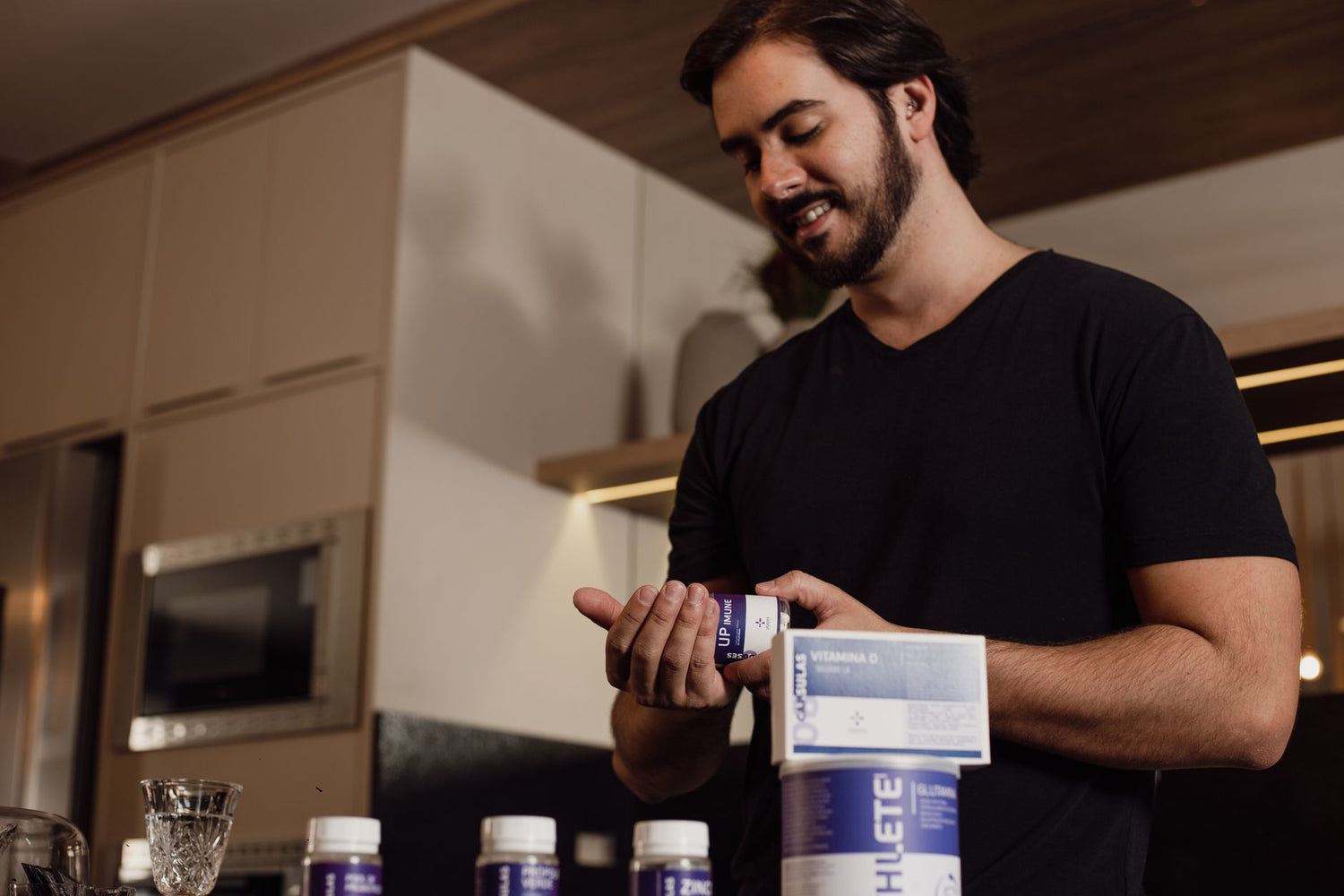
Most Noobru reviews tell you whether the reviewer liked the taste. This one audits every hero ingredient dose against the specific milligram amounts used in published clinical trials — then flags both the matches and the shortfalls. If you're searching for a Noobru review that goes beyond subjective impressions, the tables below are for you.
Full disclosure: this article is published by Noobru. We believe transparency builds trust, so we're holding our own formulas to the same scrutiny we'd apply to any competitor. Every claim links to its source.
What is Noobru and how does it work?
Noobru is a UK-based drinkable supplement brand selling single-serve sachets you mix with water. The drinkable format may support faster nutrient uptake because liquid nutrients bypass the dissolution step required by capsules and tablets.*
Each product addresses a specific area — cognitive performance, sleep, stress, immunity, or physical energy — and every ingredient dose is printed on the label. There are no proprietary blends. The current range in 2026 includes:
- Noobru Advantage — memory, focus, and brain fog (£49.95)
- Noobru Pro — energy, stress, and burnout (£55)
- Noobru Lucid — sleep and relaxation (£49.95)
- Noobru Shield — immunity and antioxidant support (£49.95)
- Noobru Sprint — pre-workout energy and focus (£49.95)
Each box contains 20 sachets — roughly a month's supply when taken on workdays.
Does Noobru Advantage have clinically studied ingredient doses?
Noobru Advantage matches clinical doses for two of its hero ingredients and falls short on two others. Here's the full breakdown:
- L-Theanine — Noobru dose: 200 mg · Study dose: 100–200 mg · ✅ At the upper end of the studied range
- Huperzine A — Noobru dose: 200 mcg · Study dose: 100–400 mcg · ✅ Mid-range
- Phosphatidylserine — Noobru dose: 50 mg · Study dose: 100–300 mg · ⚠️ Below typical study doses
- Ashwagandha — Noobru dose: 120 mg · Study dose: 300–600 mg · ⚠️ Below typical study doses
- Vitamin B5 — Noobru dose: 30 mg · Adequate intake: ~5 mg · ✅ Well above adequate intake
A 2017 study in Acta Neuropsychiatrica found that L-theanine at 250 mg/day helped support improvements in sleep quality and cognitive function*. The 200 mg dose in Advantage sits within this evidence base.
The ashwagandha and phosphatidylserine doses are lower than most stand-alone studies used. Noobru's rationale is that synergistic compounds in a multi-ingredient stack may not need identical isolated-study doses. That's a reasonable hypothesis — but genuinely debatable, and we think it's fair to flag.
Does Noobru Pro use research-backed doses for stress and energy?
Noobru Pro hits the clinical threshold for its three headline ingredients and stays deliberately conservative on caffeine. One ingredient falls below most study doses:
- Rhodiola Rosea — Noobru dose: 200 mg · Study dose: 200–600 mg · ✅ At the lower effective threshold
- Acetyl L-Carnitine — Noobru dose: 500 mg · Study dose: 500 mg+ · ✅ Matches studied dose
- Alpha GPC — Noobru dose: 150 mg · Study dose: 200–600 mg · ⚠️ Below most study doses
- Caffeine — Noobru dose: 40 mg · Typical pairing: 50–100 mg with L-Theanine · ✅ Deliberately low to avoid jitters
- Huperzine A — Noobru dose: 100 mcg · Study dose: 100–400 mcg · ✅ At the lower effective threshold
A peer-reviewed study indexed on PubMed found Rhodiola Rosea at 200 mg helped support reductions in mental fatigue alongside improvements in associative thinking and short-term memory*. The 40 mg caffeine dose is roughly half a cup of tea — sensible for a product designed for daily use without building stimulant dependence.
Alpha GPC at 150 mg is below the 600 mg used in sports-performance research, but still contributes meaningful choline for acetylcholine synthesis*.
Is Noobru Lucid effective for sleep support?
Noobru Lucid contains the strongest single-ingredient dose in the entire Noobru range: 1,000 mg of ashwagandha. Four of five hero ingredients sit within or above studied ranges:
- Ashwagandha — Noobru dose: 1,000 mg · Study dose: 300–1,000 mg · ✅ Upper end of studied range
- Lavender — Noobru dose: 250 mg · Study dose: 80–160 mg (Silexan studies) · ✅ Above typical anxiolytic doses
- L-Theanine — Noobru dose: 150 mg · Study dose: 100–200 mg · ✅ Within range
- Passion Flower — Noobru dose: 200 mg · Study dose: 90–500 mg · ✅ Within range
- Chamomile — Noobru dose: 30 mg · Study dose: 220–1,500 mg · ⚠️ Well below typical study doses
A 2012 study published in the Indian Journal of Psychological Medicine found that ashwagandha at 300 mg twice daily (600 mg total) helped support significant reductions in stress assessment scores and serum cortisol levels versus placebo*. Lucid exceeds that dose.
The chamomile at 30 mg is well below clinical study amounts, suggesting it plays a supporting flavour and aroma role rather than acting as a primary active ingredient.
What do Noobru reviews from real users say?
Users consistently praise taste and format while noting the higher price point. Aggregating publicly available reviews from the Noobru website and third-party platforms:
- Taste: Consistently praised — the drinkable format is cited as a major reason users prefer Noobru over capsules, particularly Lucid's Montmorency cherry flavour
- Noticeable effects: Users frequently report feeling calmer focus within the first week for Advantage and Pro; sleep improvements with Lucid tend to appear after 5–10 days*
- Common criticism: Price (roughly £2.50 per serving) and the 20-sachet box not covering a full calendar month
- Money-back guarantee: The 90-day return window suggests confidence in repeat-use satisfaction
How does Noobru compare to capsule nootropics?
Rather than comparing Noobru to a single competitor, the more useful comparison is format — because the drinkable sachet model is what genuinely differentiates Noobru from most of the nootropic market:
- Absorption speed: Capsules must dissolve in the stomach first (20–30 min); Noobru is already in solution — potentially faster uptake*
- Ingredient transparency: Capsule brands often use proprietary blends; Noobru lists every dose
- Pill fatigue: Noobru replaces 2–4 daily capsules with one flavoured drink
- Cost per serving: Capsules range from £0.80–£2.50; Noobru sits at £2.50–£2.75 — above average
- Portability: Individual sachets travel more easily than bottles
The trade-off is cost. At £2.50+ per serving, Noobru is pricier than budget capsule nootropics. However, budget products frequently hide individual doses behind proprietary blends, making clinical-dose verification impossible.
Our honest verdict on Noobru in 2026
After auditing ingredient doses against published research, here is our assessment:
What Noobru gets right:
- Full dose transparency — every milligram listed, no proprietary blends
- Several hero ingredients (L-Theanine, Rhodiola Rosea, Acetyl L-Carnitine, Ashwagandha in Lucid) sit at or above clinically studied doses
- The drinkable format offers a genuine differentiator in daily compliance
- 90-day money-back guarantee reduces trial risk
Where there's room for improvement:
- Phosphatidylserine, Alpha GPC, and chamomile doses fall below typical stand-alone study amounts
- Price is above market average for capsule nootropics
- 20 sachets per box doesn't cover a full 30-day month
Noobru is one of the more transparent nootropic brands available in the UK in 2026. The doses aren't perfect across every ingredient, but the fact that you can see them — and check them against the evidence yourself — is more than most brands offer.
Frequently Asked Questions
Is Noobru worth the money?
For a drinkable nootropic with fully disclosed doses, Noobru sits at a competitive price point (£49.95–£55 for 20 servings). The transparent labelling and 90-day money-back guarantee reduce the financial risk compared to brands using proprietary blends.
How long does Noobru take to work?
Ingredients like L-theanine and caffeine may produce noticeable effects within 30–60 minutes. Adaptogens such as ashwagandha and Rhodiola rosea typically require 2–4 weeks of consistent use before measurable changes in stress markers appear*.
Are there any Noobru side effects?
Noobru's ingredients are generally well tolerated at the listed doses. Some users report mild digestive adjustment in the first few days. Anyone on medication or with a health condition should consult their GP before starting.
Which Noobru product should I start with?
Noobru Advantage is the most popular starting point for general cognitive support*. If stress and energy are your primary concerns, Noobru Pro is formulated for sustained energy*. Noobru Lucid is designed for sleep and relaxation support*.
Every Noobru product comes with full dose transparency and a 90-day money-back guarantee — so you can test the formula against your own experience with zero financial risk.
Try Noobru risk-free with our 90-day guarantee →References
- Hidese S, et al. (2017). Effects of chronic l-theanine administration in patients with major depressive disorder. Acta Neuropsychiatrica, 29(2), 72-79. PubMed 28188723
- Chandrasekhar K, et al. (2012). A prospective, randomized double-blind, placebo-controlled study of safety and efficacy of a high-concentration full-spectrum extract of ashwagandha root. Indian Journal of Psychological Medicine, 34(3), 255-262. PubMed 23439798
- Hung SK, et al. (2011). The effectiveness and efficacy of Rhodiola rosea L.: a systematic review. Phytomedicine, 18(4), 235-244. PubMed 22228617
- Bellar D, et al. (2015). The effect of 6 days of alpha glycerylphosphorylcholine on isometric strength. Journal of the International Society of Sports Nutrition, 12, 42. JISSN
*These statements have not been evaluated by the Food and Drug Administration or MHRA. This product is not intended to diagnose, treat, cure, or prevent any disease. Always consult your healthcare provider before starting any supplement regimen.

Leave a comment
All comments are moderated before being published.
This site is protected by hCaptcha and the hCaptcha Privacy Policy and Terms of Service apply.