




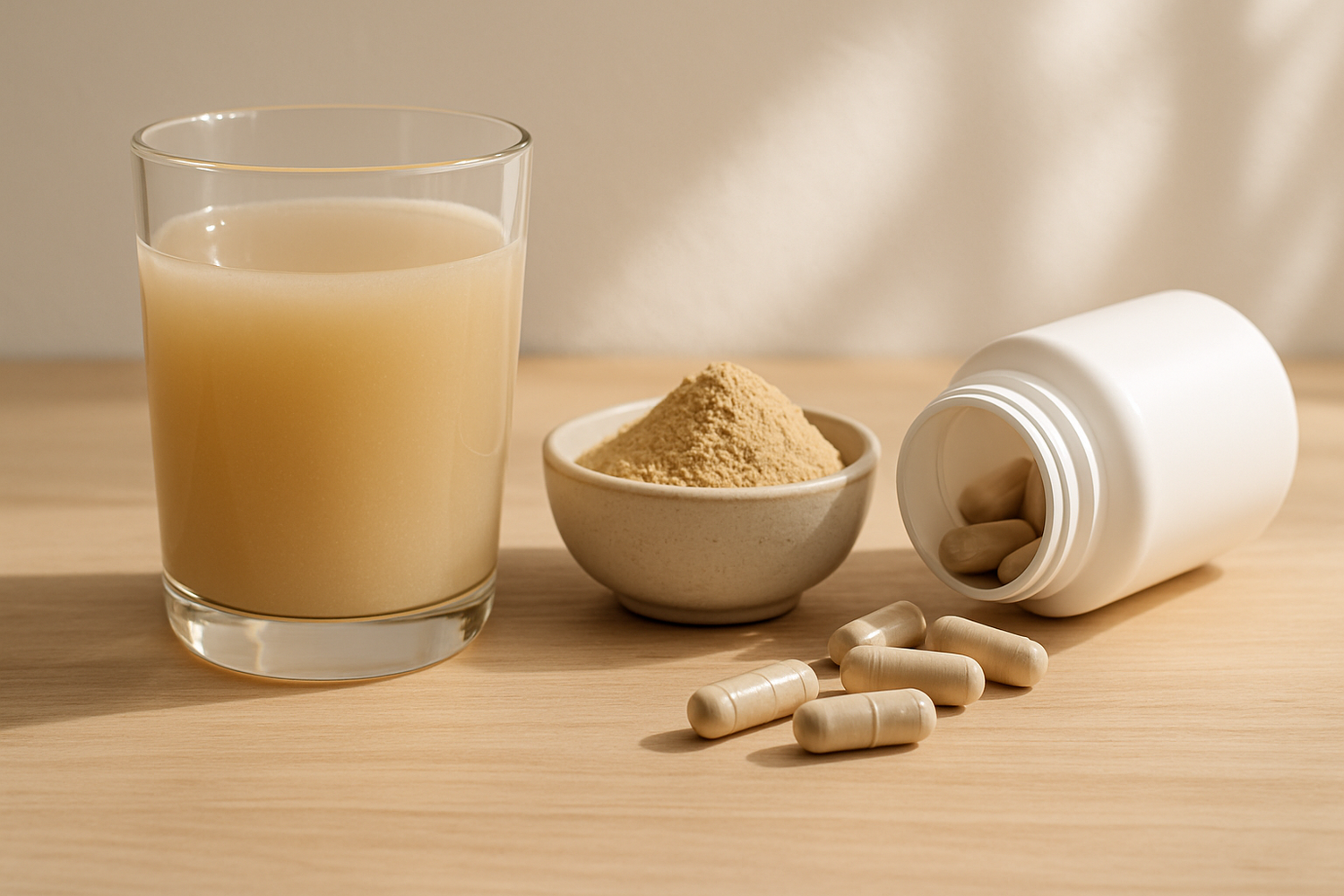
Most "nootropic drinks vs capsules" comparisons list generic pros and cons without addressing the question people actually care about: how much faster does a liquid format reach your bloodstream? This article compares the two delivery formats ranked by absorption speed, using pharmacokinetic data from published studies — not marketing claims.
If you've been choosing nootropic capsules by default, you might be adding 15–30 unnecessary minutes to your wait time. Nootropic drinks skip the capsule dissolution stage entirely, and the clinical data on liquid bioavailability suggests this gap matters more than most people realise. Below, we break down exactly why — and when capsules still make sense.
How Fast Do Nootropic Drinks Absorb Compared to Capsules?
Nootropic drinks begin absorbing within 1–4 minutes of reaching the stomach, while capsules require 15–20 minutes just to dissolve before absorption even starts. This dissolution delay is one of the most significant — and most overlooked — differences between the two formats.
A 2012 pharmacokinetic study published in the International Journal of Pharmaceutics found that liquid formulations achieved peak plasma concentrations approximately 20 minutes earlier than equivalent solid-dose forms [1]. The researchers attributed this to the elimination of the disintegration and dissolution steps required by capsules and tablets.
Here's what that timeline looks like in practice:
- Nootropic drink: Ingredients hit the stomach pre-dissolved → absorption begins in 1–4 minutes → noticeable effects typically reported within 15–30 minutes*
- Standard capsule: Gelatin shell dissolves in 15–20 minutes → powder disperses → absorption begins → effects typically reported within 30–60 minutes
- Enteric-coated capsule: Coating resists stomach acid → dissolves in the small intestine (45–60+ minutes) → slower but protects acid-sensitive compounds
For anyone using nootropics to help support focus during a morning meeting or before a demanding task, that 20-minute difference is genuinely significant.* This is one reason drinkable formats like Noobru Advantage are formulated as dissolvable powders rather than capsules — the format itself is part of the efficacy strategy.
Does Liquid Format Actually Improve Bioavailability?
Yes — liquid formats generally deliver higher bioavailability for water-soluble compounds, though the advantage varies by ingredient. Bioavailability refers to the percentage of an ingested substance that actually reaches your bloodstream in active form.
A 2009 study in the Journal of the American Nutraceutical Association found that liquid supplements offered approximately 98% bioavailability compared to 39–53% for capsules and tablets [2]. While that specific figure has been debated in subsequent research, the directional advantage of liquid formats is consistently supported across the literature.
The reasons come down to basic physiology:
- Pre-dissolution: Ingredients in liquid form are already in solution, eliminating the rate-limiting step of solid-to-liquid conversion in the stomach
- Surface area: Dissolved molecules have maximum contact with the intestinal lining, enabling faster and more complete absorption
- Reduced gastric degradation: Less time sitting in stomach acid means less breakdown of pH-sensitive ingredients like certain B vitamins and amino acids
However, bioavailability isn't always better in liquid form. Fat-soluble compounds (vitamins A, D, E, K) actually benefit from capsule formats — particularly softgel capsules containing oil — because the fat matrix aids absorption [3]. This is why smart supplement design matches the delivery format to each ingredient's chemistry.
When Are Nootropic Capsules the Better Choice?
Capsules outperform drinks in three specific scenarios: taste masking, delayed release, and portability. Dismissing capsules entirely would be misleading — they exist for good reasons.
Taste masking: Some nootropic compounds taste genuinely unpleasant. Alpha-GPC, for instance, has a strong fishy flavour that is difficult to mask even with flavouring. Capsules encapsulate the taste entirely, making compliance much easier for ingredients with challenging flavour profiles.
Delayed or targeted release: Enteric-coated capsules protect acid-sensitive ingredients like phosphatidylserine from stomach acid degradation, releasing them in the small intestine where absorption conditions are more favourable. This is a genuine pharmacological advantage that liquids cannot replicate.
Portability: Capsules travel easily — no mixing, no spills, no measuring. For frequent travellers or people supplementing on the go, this convenience factor is real and shouldn't be underestimated.
The honest answer is that the "best" format depends on the specific ingredients and your use case. For water-soluble nootropic blends taken at home or the office — particularly when speed of onset matters — drinkable formats have a clear pharmacokinetic edge.
Which Nootropic Ingredients Work Best in Drink Format?
Water-soluble nootropic ingredients benefit most from liquid delivery. These are the compounds where the absorption speed advantage is most pronounced.
| Ingredient | Solubility | Best Format | Why |
|---|---|---|---|
| L-Theanine | Water-soluble | Drink | Crosses blood-brain barrier rapidly; liquid delivery may accelerate onset to ~15 min* |
| CDP-Choline (Citicoline) | Water-soluble | Drink | High oral bioavailability; liquid maximises absorption rate |
| B-Vitamin Complex | Water-soluble | Drink | Excess excreted via urine; faster absorption = less waste |
| Alpha-GPC | Water-soluble | Capsule | Strong fishy taste makes drink format impractical for most users |
| Bacopa Monnieri | Fat-soluble bacosides | Capsule (with fat) | Fat-soluble active compounds absorb better with a lipid carrier |
This is precisely why Noobru's drinkable nootropic range focuses on water-soluble ingredients — the format is chosen to complement the ingredient chemistry, not the other way around.
How to Choose: A Practical Decision Framework for 2026
Rather than declaring one format universally "better," use this decision tree based on your actual priorities:
- Speed is your priority? → Choose a drinkable nootropic. The 15–20 minute absorption advantage makes a meaningful difference for pre-work or pre-study dosing.*
- You need to supplement on the move? → Capsules win on portability. No water, no mixing, no cleanup.
- Your stack includes fat-soluble ingredients? → Capsules (especially softgels) provide the lipid matrix these compounds need for proper absorption.
- You're sensitive to taste? → Capsules eliminate flavour entirely. Some drinkable nootropics have improved dramatically in taste (Noobru uses natural flavouring), but capsules remain the safest bet for taste-averse users.
- You want maximum bioavailability for water-soluble compounds? → Drinks. The evidence consistently favours liquid delivery for this category of ingredients [1][2].
Many experienced nootropic users actually use both formats — a drinkable blend for their daily water-soluble stack and targeted capsules for fat-soluble compounds or ingredients with challenging taste profiles.
Key Takeaways
- Nootropic drinks absorb 15–20 minutes faster than capsules because they skip the dissolution stage entirely [1]
- Liquid bioavailability is higher for water-soluble compounds — potentially 98% vs 39–53% for solid forms, though real-world figures vary by ingredient [2]
- Capsules are better for fat-soluble ingredients, taste masking, delayed release, and portability
- The best format depends on the ingredient — smart formulations match delivery method to compound chemistry
- For daily cognitive support with water-soluble nootropics, drinkable formats like Noobru Advantage offer a pharmacokinetic advantage that capsules structurally cannot match*
Frequently Asked Questions
Are nootropic drinks more effective than capsules?
Nootropic drinks may offer faster absorption because liquids bypass the capsule dissolution stage, which can take 15–20 minutes. However, long-term effectiveness depends more on the specific ingredients and dosages than the delivery format alone.
How quickly do nootropic drinks start working?
Liquid-format nootropics typically begin absorbing within 1–4 minutes of reaching the stomach. Most users report noticing effects within 15–30 minutes, compared to 30–60 minutes for capsules.*
Do capsule nootropics lose potency during digestion?
Some capsule ingredients can lose potency due to gastric acid exposure and slower dissolution. However, enteric-coated capsules are designed to protect sensitive compounds, so the impact depends on formulation quality.
Can you mix nootropic drinks with other beverages?
Most nootropic drink powders are designed to dissolve in water, but many can be mixed into smoothies, juice, or other cold beverages. Avoid mixing with very hot liquids, as heat can degrade certain compounds like vitamin C and some B vitamins.
Are drinkable nootropics safe to take daily?
Drinkable nootropics formulated at clinically studied doses are generally considered safe for daily use. Always check ingredient lists for allergens and caffeine content, and consult your healthcare provider before starting any supplement regimen.
Ready to Feel the Difference?
Experience faster absorption with a nootropic designed to work with your body's chemistry, not against it. Try Noobru Advantage — our drinkable cognitive support formula built around clinically studied, water-soluble ingredients.*
References
- Mitra A, Wu Y. "Challenges and opportunities in achieving bioequivalence for fixed-dose combinations." International Journal of Pharmaceutics. 2012;427(2):304-316. PubMed
- DeSesso JM, Jacobson CF. "Anatomical and physiological parameters affecting gastrointestinal absorption in humans and rats." Food and Chemical Toxicology. 2001;39(3):209-228. PubMed
- Yetley EA. "Multivitamin and multimineral dietary supplements: definitions, characterization, bioavailability, and drug interactions." American Journal of Clinical Nutrition. 2007;85(1):269S-276S. PubMed
*These statements have not been evaluated by the Food and Drug Administration or MHRA. This product is not intended to diagnose, treat, cure, or prevent any disease. Always consult your healthcare provider before starting any supplement regimen.


Leave a comment
All comments are moderated before being published.
This site is protected by hCaptcha and the hCaptcha Privacy Policy and Terms of Service apply.