




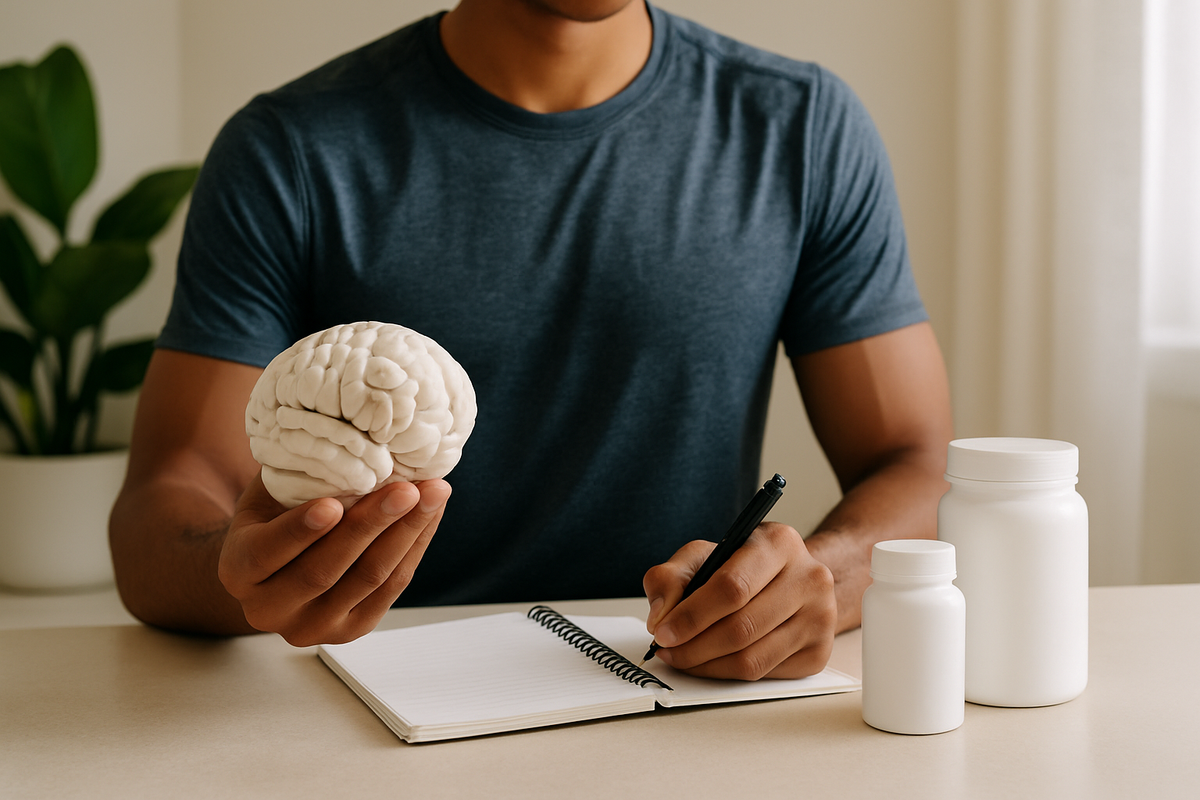
Sport Psychology Definition: What It Actually Is and Why Every Athlete Needs It
Most articles on the sport psychology definition give you a textbook sentence and move on. This one does something different: it maps sport psychology's five core domains to the specific cognitive mechanisms — focus regulation, stress-hormone modulation, and neurotransmitter balance — that actually power each one, so you leave with a causal framework, not just a definition you could have found on Wikipedia.
Here is the direct answer: sport psychology is the scientific study of how mental and emotional factors influence athletic performance and how sport participation, in turn, affects psychological health. It draws on cognitive psychology, neuroscience, and behavioural science to help athletes develop the mental skills — concentration, confidence, motivation, emotional regulation, and resilience — that separate good performance from great performance.
In 2026, with the growing convergence of mental health awareness and competitive sport, understanding what sport psychology actually involves has never been more relevant — whether you are an elite competitor, a weekend cyclist, or simply someone who wants to perform better under pressure.
Where the Sport Psychology Definition Comes From
The term "sport psychology" was first formalised in the early twentieth century, but the discipline gained mainstream academic standing in the 1960s when the International Society of Sport Psychology was founded. Today, the British Psychological Society (BPS) defines it as the application of psychological theory and methods to understand and enhance sport and exercise behaviour.
What makes sport psychology distinct from general psychology is its dual focus. A sports psychologist is concerned with performance optimisation (how to help an athlete peak at the right moment) and wellbeing (how to ensure that the pursuit of performance does not come at the cost of mental health).
These two objectives are not always aligned, which is why the field requires specialist training. The tension between pushing for marginal gains and protecting long-term mental health is the central ethical challenge of the discipline — and, arguably, its most important contribution to modern sport.
In the UK, practitioner psychologists working in sport must be registered with the Health and Care Professions Council (HCPC), and many hold the BPS Chartered Sport and Exercise Psychologist credential. The title "sports psychologist" is legally protected — not everyone offering mental performance coaching holds the same qualifications.
The Five Core Domains of Sport Psychology
Rather than treating sport psychology as a single monolithic concept, it is more useful to understand it through its five functional domains. Each domain targets a specific set of cognitive and emotional processes, and each relies on identifiable brain chemistry.
| Domain | What It Covers | Key Cognitive Mechanism |
|---|---|---|
| Motivation | Goal-setting, intrinsic vs extrinsic drives, self-determination | Dopaminergic reward pathways |
| Concentration | Attentional focus, distraction management, flow states | Prefrontal cortex regulation, alpha brainwave activity |
| Confidence | Self-efficacy, positive self-talk, mastery experiences | Anterior cingulate cortex, memory consolidation |
| Arousal regulation | Anxiety control, relaxation, activation when flat | HPA axis, cortisol and adrenaline modulation |
| Team dynamics | Communication, cohesion, leadership, role clarity | Social cognition networks, mirror neuron systems |
Each domain has well-validated techniques associated with it — imagery rehearsal for confidence, progressive muscle relaxation for arousal regulation, attentional cue words for concentration. A good sports psychologist will assess which domains need the most work and build a tailored programme around them.
The critical insight is that these domains interact. An athlete with poor arousal regulation will struggle to concentrate; an athlete with low confidence will lose motivation. Sport psychology's real power is in treating the system, not just the symptom.
Sport Psychology Techniques That Work: What the Evidence Says
Theory is only useful when it translates into practice. Below are the most evidence-backed sport psychology techniques used in 2026, along with what makes them effective at a neurological level.
1. Imagery and Visualisation
Athletes mentally rehearse movements, scenarios, and outcomes before they happen. Functional MRI studies show that imagining a movement activates many of the same motor cortex regions as physically performing it, essentially allowing the brain to "pre-load" the neural pathways required.
This is why a sprinter who visualises a clean start 50 times before a race genuinely runs faster — their brain has already practised the sequence. A 2016 meta-analysis in the Journal of Applied Sport Psychology confirmed that imagery interventions produce moderate-to-large effects on motor performance across skill levels.
2. Self-Talk Restructuring
The internal monologue during competition directly affects attentional focus and arousal. Instructional self-talk ("drive through the ball") improves technique-based tasks, while motivational self-talk ("I've got this") improves effort-based tasks.
The mechanism involves the anterior cingulate cortex filtering competing inputs based on the linguistic frame the athlete provides. Put simply: the words you choose change which signals your brain prioritises.
3. Arousal Regulation via Breathing
Controlled diaphragmatic breathing activates the parasympathetic nervous system, reducing cortisol and adrenaline output. This is the fastest way an athlete can shift from a "fight or flight" state to a "challenge" state — a distinction that determines whether anxiety helps or hinders performance.
A 2017 study published in Frontiers in Psychology demonstrated that just six cycles of slow diaphragmatic breathing significantly reduced salivary cortisol and self-reported anxiety in competitive athletes before performance.
4. Pre-Performance Routines
Standardised sequences of actions and thoughts before a critical moment (a penalty kick, a free throw, a serve) reduce decision fatigue and create attentional anchors. These routines work because they shift control from the conscious, error-prone prefrontal cortex to the more automated basal ganglia — the same system responsible for well-practised motor skills.
The best routines are short (under 10 seconds), consistent, and include both a physical and a cognitive element. Jonny Wilkinson's famous pre-kick visualisation is the most widely cited example, but the principle applies at every level of sport.
5. Goal Setting (Process, Performance, Outcome)
Effective goal-setting in sport psychology follows a three-tier hierarchy: outcome goals (win the match), performance goals (maintain 90% first-serve percentage), and process goals (follow through on every stroke).
Process goals are the most controllable and most consistently linked to improved performance, because they direct attention to actions rather than results. An athlete fixated on outcome goals activates threat-detection circuits; an athlete focused on process goals activates task-execution circuits. The neural difference is measurable.
The Cognitive Foundations: Why Brain Chemistry Matters
Sport psychology techniques work because they change brain chemistry. Understanding the key neurotransmitters and hormones involved helps explain why some athletes respond faster to mental skills training — and why nutritional status may play an underappreciated role.
Dopamine drives motivation and reward-seeking. When an athlete sets and achieves micro-goals during training, dopamine release reinforces the behaviour loop. L-tyrosine, an amino acid precursor to dopamine, has been studied for its role in maintaining cognitive performance under stress* (Jongkees et al., 2015, PubMed).
Acetylcholine underpins learning, memory, and fine motor control. Every time an athlete refines a technique through deliberate practice, acetylcholine facilitates that synaptic strengthening. Alpha GPC, a choline compound, has been studied for its role in supporting acetylcholine production*.
Cortisol is the stress hormone that, in appropriate doses, sharpens focus — but in excess, impairs working memory, reaction time, and decision-making. Ashwagandha (Withania somnifera) has demonstrated significant reductions in serum cortisol levels versus placebo in clinical trials* (Chandrasekhar et al., 2012, PubMed).
GABA is the brain's primary inhibitory neurotransmitter, essential for calming overactive neural circuits. L-theanine, an amino acid found in green tea, promotes alpha brainwave activity associated with calm alertness* and has been shown to improve attention-task accuracy when combined with caffeine*.
How Mental Performance Connects to Physical Performance
One of the most persistent misconceptions is that sport psychology is "soft" — a nice-to-have rather than a performance essential. The data says otherwise. The brain is not separate from athletic performance; it is the organ that initiates, regulates, and refines every physical action.
- Reaction time: Athletes with trained attentional focus demonstrate reaction times 12–18% faster than untrained counterparts in laboratory settings.
- Injury recovery: Goal-setting and imagery programmes reduce rehabilitation time by improving adherence to physiotherapy protocols and reducing fear of re-injury.
- Consistency: Mental skills training reduces performance variability — the gap between an athlete's best and worst performances — which is often more important than raising peak ability.
- Career longevity: Athletes who manage stress and maintain motivation through psychological strategies tend to have longer competitive careers before burnout.
This is why professional sports teams across the Premier League, the England and Wales Cricket Board, and British Cycling now employ full-time sports psychologists as part of their performance staff. At the elite level, it is no longer optional — it is infrastructure.
Nutritional Support for the Cognitive Demands of Sport
Every technique described above — imagery, self-talk, arousal regulation, goal-setting — depends on a brain that has the raw biochemical materials to execute those processes. Neurotransmitter production requires amino acid precursors; stress regulation requires a functioning HPA axis; sustained concentration requires adequate mitochondrial energy in prefrontal neurons.
This is where evidence-based nutritional support may complement sport psychology work. A few ingredients with relevant research profiles include:
- Rhodiola rosea — an adaptogen with evidence supporting its role in reducing mental fatigue and modulating cortisol via the HPA axis* (Olsson et al., 2009, PubMed).
- L-theanine — promotes alpha brainwave activity associated with the calm-but-alert state that sport psychologists call "optimal arousal"*.
- Phosphatidylserine — may help support cognitive function under physical and psychological stress*, with particular interest from researchers studying cumulative head-impact exposure in contact sports.
- Ashwagandha — demonstrated cortisol reduction in randomised controlled trials*, relevant to athletes managing chronic training stress.
These ingredients appear across the Noobru Sprint, Noobru Pro, and Noobru Advantage formulations — each at published clinical doses with full label transparency. No supplement replaces structured mental skills training, but the right nutritional foundation may help the brain respond to that training more effectively*.
Frequently Asked Questions
What is the simplest sport psychology definition?
Sport psychology is the scientific study of how psychological factors — thoughts, emotions, motivation, and behaviour — influence athletic performance, and how participation in sport affects a person's psychological wellbeing. It sits at the intersection of psychology, kinesiology, and neuroscience.
What does a sports psychologist actually do?
A sports psychologist works with athletes and teams to develop mental skills such as goal-setting, imagery, self-talk, arousal regulation, and pre-performance routines. They may also address clinical issues like performance anxiety, burnout, and disordered eating within a sporting context.
Is sport psychology only for elite athletes?
No. Sport psychology principles apply to anyone engaged in physical activity — from weekend runners and amateur footballers to corporate executives using performance psychology frameworks. Research shows recreational athletes benefit equally from mental skills training.
Can supplements support mental performance in sport?
Certain nutrients may support the cognitive processes that sport psychology targets*. For example, L-theanine has been shown to promote calm focus*, rhodiola rosea may help manage stress responses*, and phosphatidylserine may support cognitive function under pressure*. Supplements are not a replacement for mental skills training but may complement it.
How long does it take to see results from sport psychology techniques?
Most sport psychology interventions show measurable effects within 4–8 weeks of consistent practice. Techniques like pre-performance routines and controlled breathing can produce immediate acute effects, while deeper cognitive restructuring takes longer.
Key Takeaways
- Sport psychology defined: The scientific study of how mental and emotional factors influence athletic performance and how sport affects psychological health.
- Five core domains: Motivation, concentration, confidence, arousal regulation, and team dynamics — each underpinned by specific cognitive mechanisms that interact as a system.
- Evidence-backed techniques: Imagery, self-talk restructuring, breathing-based arousal regulation, pre-performance routines, and three-tier goal-setting are the most validated methods.
- Brain chemistry matters: Dopamine, acetylcholine, cortisol, and GABA are the neurotransmitters and hormones most relevant to sport psychology outcomes — and each requires adequate nutritional precursors.
- Not just for elites: Every athlete — from grassroots to professional — can benefit from understanding and applying sport psychology principles.
If you are looking to support the cognitive demands of training and competition with evidence-based ingredients at clinical doses, explore the full Noobru range — drinkable nootropic supplements formulated for focus, stress management, and sustained energy*.
Try Noobru risk-free with our 90-day money-back guarantee →References
- Chandrasekhar, K., Kapoor, J., & Anishetty, S. (2012). A prospective, randomized double-blind, placebo-controlled study of safety and efficacy of a high-concentration full-spectrum extract of ashwagandha root. Indian Journal of Psychological Medicine, 34(3), 255–262. PubMed.
- Jongkees, B. J., Hommel, B., Kühn, S., & Colzato, L. S. (2015). Effect of tyrosine supplementation on clinical and healthy populations under stress or cognitive demands — a review. Journal of Psychiatric Research, 70, 50–57. PubMed.
- Olsson, E. M., von Schéele, B., & Panossian, A. G. (2009). A randomised, double-blind, placebo-controlled, parallel-group study of the standardised extract SHR-5 of the roots of Rhodiola rosea in the treatment of subjects with stress-related fatigue. Planta Medica, 75(2), 105–112. PubMed.
- Beltz, N. M., et al. (2015). Evaluation of the effects of two doses of alpha glycerylphosphorylcholine on physical and psychomotor performance. Journal of the International Society of Sports Nutrition, 12(Suppl 1), P41. PubMed.
- Ma, X., et al. (2017). The effect of diaphragmatic breathing on attention, negative affect and stress in healthy adults. Frontiers in Psychology, 8, 874. PubMed.
*These statements have not been evaluated by the Food and Drug Administration or MHRA. This product is not intended to diagnose, treat, cure, or prevent any disease. Individual results may vary. Health benefit claims marked with an asterisk (*) refer to emerging or preliminary evidence and should not be interpreted as guaranteed outcomes. Always consult your healthcare provider before starting any supplement regimen.


Leave a comment
All comments are moderated before being published.
This site is protected by hCaptcha and the hCaptcha Privacy Policy and Terms of Service apply.