




Nutritional Science Writer · 12 years in cognitive nutrition research · Former lecturer in nutritional biochemistry, University of Leeds
Reviewed: 27 September 2026
An adrenal gland blood test doesn't just diagnose rare conditions like Addison's disease — it reveals the hormone levels most directly responsible for your ability to concentrate, sustain energy, and think clearly under pressure. Yet most articles on adrenal testing stop at explaining reference ranges, leaving you with numbers but no context for how those numbers connect to daily cognitive performance. This guide bridges that gap: for each adrenal marker your blood test measures, we explain the specific focus, energy, and brain fog symptoms it governs, what your results actually mean in 2026, and what evidence-based steps you can take in response.
Important note: this article is for educational purposes only. If your GP has ordered an adrenal gland blood test or you're experiencing symptoms of adrenal dysfunction, always follow your doctor's guidance for diagnosis and treatment.
What Does an Adrenal Gland Blood Test Actually Measure?
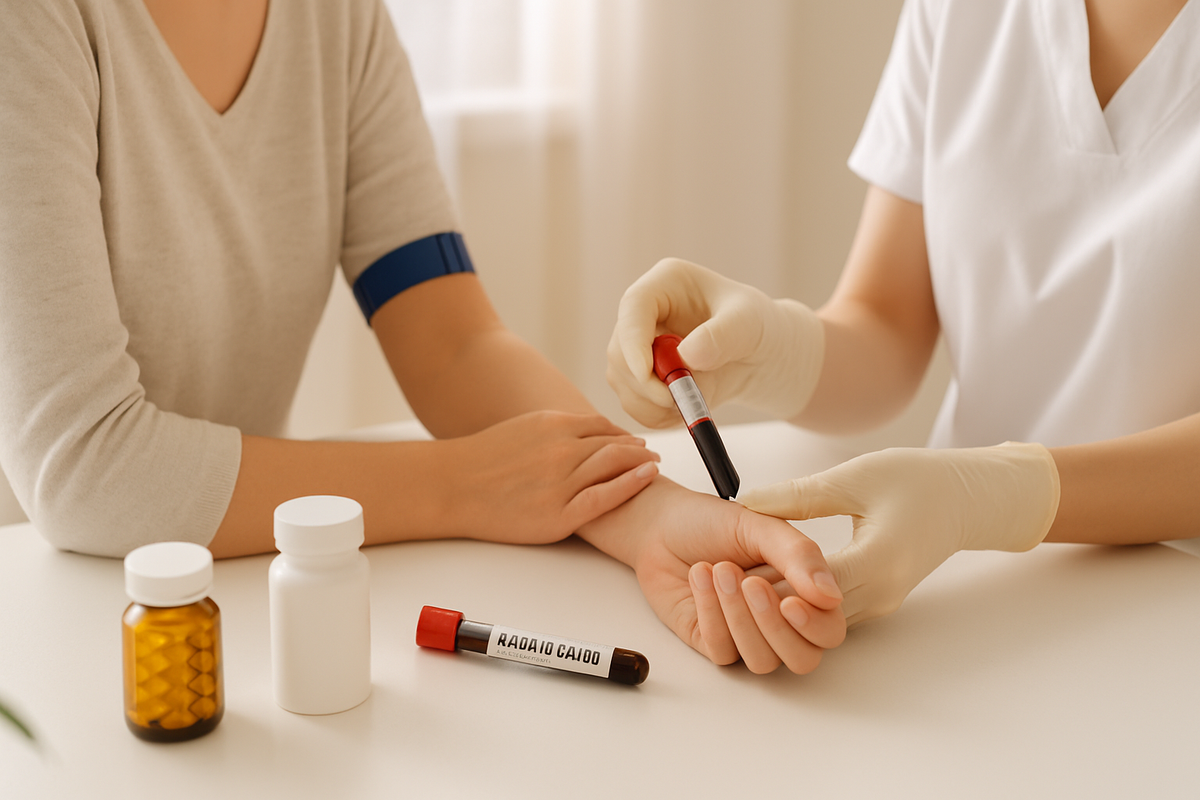
An adrenal gland blood test measures the hormones produced by your adrenal glands — two small glands that sit on top of your kidneys. The three markers most relevant to cognitive function are cortisol, DHEA-S, and ACTH.
Cortisol: Your Stress and Alertness Hormone
Cortisol is the primary hormone measured in an adrenal function test. Normal morning cortisol typically falls between 166–507 nmol/L (6–18.4 µg/dL), though reference ranges vary by laboratory. Cortisol follows a natural daily rhythm called the diurnal curve — highest within 30–45 minutes of waking (the cortisol awakening response), then declining throughout the day.
What makes cortisol so relevant to focus: it directly modulates the prefrontal cortex, the brain region responsible for working memory, decision-making, and attention control. A 2006 study in Biological Psychiatry found that both abnormally high and abnormally low cortisol levels impaired cognitive performance in healthy adults [1]. The relationship isn't linear — it's an inverted U-curve, where moderate cortisol supports sharp thinking, but extremes in either direction degrade it.
DHEA-S: The Cortisol Counterbalance
DHEA-S (dehydroepiandrosterone sulphate) is often called the "anti-stress" adrenal hormone because it counterbalances cortisol's effects. Your adrenal gland blood test may include DHEA-S to assess the cortisol-to-DHEA ratio — a marker increasingly used by integrative practitioners to evaluate chronic stress load.
A high cortisol-to-DHEA ratio suggests your adrenals are prioritising stress hormones at the expense of regenerative ones. A 2010 study in Psychoneuroendocrinology linked elevated cortisol-to-DHEA ratios with poorer performance on memory tasks and increased subjective fatigue [2].
ACTH: The Upstream Signal
ACTH (adrenocorticotropic hormone) isn't produced by the adrenals — it's released by the pituitary gland to tell the adrenals how much cortisol to make. Testing ACTH alongside cortisol helps your doctor distinguish between adrenal problems (the glands themselves) and pituitary problems (the signal). Think of it like this: ACTH is the thermostat; cortisol is the temperature.
How Adrenal Imbalances Affect Focus and Mental Clarity
The connection between your adrenal gland blood test results and your daily cognitive experience is more direct than most people realise. Here's how each pattern typically manifests:
High Cortisol: The "Wired but Unfocused" Pattern
Chronically elevated cortisol — often seen in people under sustained work stress, sleep-deprived individuals, or those consuming excessive caffeine — tends to produce a specific cluster of cognitive symptoms:
- Difficulty concentrating despite feeling alert or restless
- Poor working memory (reading the same paragraph three times)
- Racing thoughts that prevent sustained attention on a single task
- Disrupted sleep, which compounds cognitive decline the next day
A 2007 review in Neuroscience & Biobehavioral Reviews documented how chronic cortisol elevation can reduce hippocampal volume over time — quite literally shrinking the brain's memory centre [3].
Low Cortisol: The "Flat and Foggy" Pattern
Abnormally low cortisol (as seen in adrenal insufficiency) produces a different cognitive profile: pervasive brain fog, difficulty initiating tasks, slow processing speed, and physical fatigue that no amount of coffee seems to fix. If your adrenal gland blood test shows cortisol consistently below the reference range, your GP will likely investigate further — this requires medical attention, not supplements.
The Cortisol Curve Matters More Than a Single Number
"Your morning cortisol could be 'normal' while your afternoon cortisol stays abnormally high — and that flattened curve is where the brain fog lives." This is why some practitioners recommend a four-point salivary cortisol test alongside standard blood work: it captures the full daily pattern rather than a single snapshot.
What to Do After Getting Your Results
Your adrenal gland blood test results fall into one of three practical categories. Always discuss results with your GP or endocrinologist before taking action.
1. Clinically Abnormal Results: See Your Doctor
If your cortisol is significantly outside the reference range, or your ACTH is elevated, this may indicate conditions like Cushing's syndrome (high cortisol) or Addison's disease (low cortisol). These are medical conditions that require medical treatment — not lifestyle changes or supplements.
2. "High-Normal" or Stress-Elevated Cortisol: Lifestyle + Targeted Nutrition
Many people fall into this category: cortisol within the reference range but consistently at the upper end, often with symptoms of poor focus, disrupted sleep, or afternoon energy crashes. After consulting your healthcare provider, evidence-based strategies include:
- Sleep hygiene: Cortisol and sleep exist in a bidirectional relationship. A study in Sleep showed that even partial sleep deprivation elevates next-day cortisol by up to 37% [4].
- Structured exercise: Moderate aerobic exercise (30 minutes, 3–5 times weekly) has been shown to normalise cortisol patterns over 8–12 weeks.
- Adaptogenic herbs: Rhodiola rosea and ashwagandha have both demonstrated cortisol-moderating effects in clinical trials (more on these below).*
- L-theanine: A 2019 study in Nutrients found that 200 mg of L-theanine may help reduce subjective stress responses and support cortisol regulation in adults under psychological stress [5].*
3. Optimal Range Results with Persistent Symptoms: Look Elsewhere
If your adrenal gland blood test comes back perfectly normal but you still experience focus problems, the cause likely lies outside adrenal function — consider thyroid markers, iron/ferritin, vitamin D, or B12 as next steps with your GP.
Nutrients and Ingredients That May Support Adrenal Health
The following ingredients have clinical evidence suggesting they may help support healthy adrenal function and cortisol regulation. None of these replace medical treatment for diagnosed adrenal conditions — they're relevant for people in the "high-normal" category described above, and should be discussed with a healthcare provider.*
Rhodiola Rosea
A 2012 systematic review in BMC Complementary and Alternative Medicine concluded that Rhodiola rosea may help reduce mental fatigue under stressful conditions [6]. The proposed mechanism involves modulating the HPA axis — the very system your adrenal gland blood test evaluates. The HPA axis (hypothalamic-pituitary-adrenal axis) is the communication pathway between your brain and adrenal glands that controls cortisol release.* Typical studied dose: 200–600 mg daily of an extract standardised to 3% rosavins.
Phosphatidylserine
This phospholipid may help blunt excessive cortisol responses to stress.* A 2008 study found that 400 mg of phosphatidylserine daily for two weeks significantly reduced cortisol response to exercise-induced stress [7]. It also supports cell membrane integrity in the brain — the outer layer of brain cells that enables them to communicate efficiently.*
Bacopa Monnieri
While primarily studied for memory, Bacopa has adaptogenic properties — meaning it may help the body resist physiological stress.* A 2014 meta-analysis in the Journal of Ethnopharmacology found that Bacopa may help improve attention and cognitive processing after 4–6 weeks of daily use [8]. The active compounds, called bacosides, appear to support communication between brain cells over time.* Studied dose: 300 mg daily standardised to 50% bacosides.
How These Ingredients Work Together
The most effective approach layers fast-acting and slow-building ingredients. L-theanine may help with same-day calm alertness, while Rhodiola and Bacopa build benefits over weeks.* If you're curious about how these ingredients support focus beyond the adrenal context, our guide to the best nootropic supplements for focus ranks them by speed-to-effect.
Formulated blends like Noobru Advantage combine several of these evidence-backed ingredients — including L-theanine — into a single daily serving, which may simplify the process if you'd rather not source and dose each one individually.*
Key Takeaways: Adrenal Gland Blood Test and Cognitive Health
- An adrenal gland blood test measures cortisol, DHEA-S, and ACTH — three hormones that directly govern your stress response, energy levels, and ability to focus.
- Cortisol affects cognition in an inverted U-curve: too high impairs working memory and causes restless unfocus; too low causes flat brain fog and fatigue.
- The cortisol-to-DHEA ratio may be more informative than cortisol alone for understanding chronic stress effects on the brain.
- Clinically abnormal results require medical treatment — supplements and lifestyle changes are appropriate for "high-normal" stress-related patterns, not diagnosed conditions.
- L-theanine, Rhodiola rosea, phosphatidylserine, and Bacopa monnieri all have clinical evidence suggesting they may help support healthy cortisol regulation and cognitive function.*
- Sleep, exercise, and stress management remain the most impactful interventions for cortisol regulation — treat supplements as complementary support, not replacements.
Frequently Asked Questions
What does an adrenal gland blood test measure?
An adrenal gland blood test typically measures cortisol and DHEA-S levels. Some panels also include ACTH, aldosterone, and adrenaline. Together, these markers show how well your adrenal glands regulate your stress response, energy, and cognitive function.
Can high cortisol cause brain fog?
Yes. Chronically elevated cortisol has been linked to impaired working memory, reduced attention span, and persistent brain fog. A 2006 study in Biological Psychiatry found that sustained high cortisol levels were associated with decreased cognitive performance in otherwise healthy adults [1].
How much does an adrenal gland blood test cost in the UK?
Through the NHS, adrenal blood tests are free when requested by your GP based on clinical need. Private testing through providers like Medichecks or Thriva typically costs £39–£89 for a cortisol panel, or £99–£159 for a comprehensive adrenal profile including DHEA-S and ACTH.
What supplements support healthy cortisol levels?
Adaptogens such as Rhodiola rosea, ashwagandha, and Bacopa monnieri have clinical evidence suggesting they may help support healthy cortisol regulation.* L-theanine and phosphatidylserine have also shown promise in studies for moderating the cortisol stress response.*
Should I get an adrenal blood test if I have chronic fatigue?
It's worth discussing with your GP. Chronic fatigue can stem from many causes, but abnormal cortisol or DHEA-S levels are a medically recognised factor. A blood test helps rule out adrenal insufficiency or Cushing's syndrome, both of which require medical treatment.
References
- Lupien SJ, et al. "The effects of stress and stress hormones on human cognition." Biological Psychiatry, 2006. PubMed
- Heaney JLJ, et al. "DHEA-S and cortisol in relation to cognitive function." Psychoneuroendocrinology, 2010. PubMed
- Lupien SJ, et al. "Effects of stress throughout the lifespan on the brain." Neuroscience & Biobehavioral Reviews, 2007. PubMed
- Leproult R, et al. "Sleep loss results in an elevation of cortisol levels the next evening." Sleep, 1997. PubMed
- Hidese S, et al. "Effects of L-theanine administration on stress-related symptoms." Nutrients, 2019. PubMed
- Ishaque S, et al. "Rhodiola rosea L. for physical and mental fatigue." BMC Complementary and Alternative Medicine, 2012. PubMed
- Starks MA, et al. "The effects of phosphatidylserine on endocrine response to exercise stress." Medicine & Science in Sports & Exercise, 2008. PubMed
- Kongkeaw C, et al. "Meta-analysis of Bacopa monnieri on cognitive function." Journal of Ethnopharmacology, 2014. PubMed
Looking for evidence-based cognitive support?
Explore Noobru Advantage → — formulated with L-theanine and other clinically studied ingredients to help support focus and mental clarity.* Or browse the full Noobru supplement range.
*These statements have not been evaluated by the Food and Drug Administration or MHRA. This product is not intended to diagnose, treat, cure, or prevent any disease. Always consult your healthcare provider before starting any supplement regimen.



Leave a comment
All comments are moderated before being published.
This site is protected by hCaptcha and the hCaptcha Privacy Policy and Terms of Service apply.