




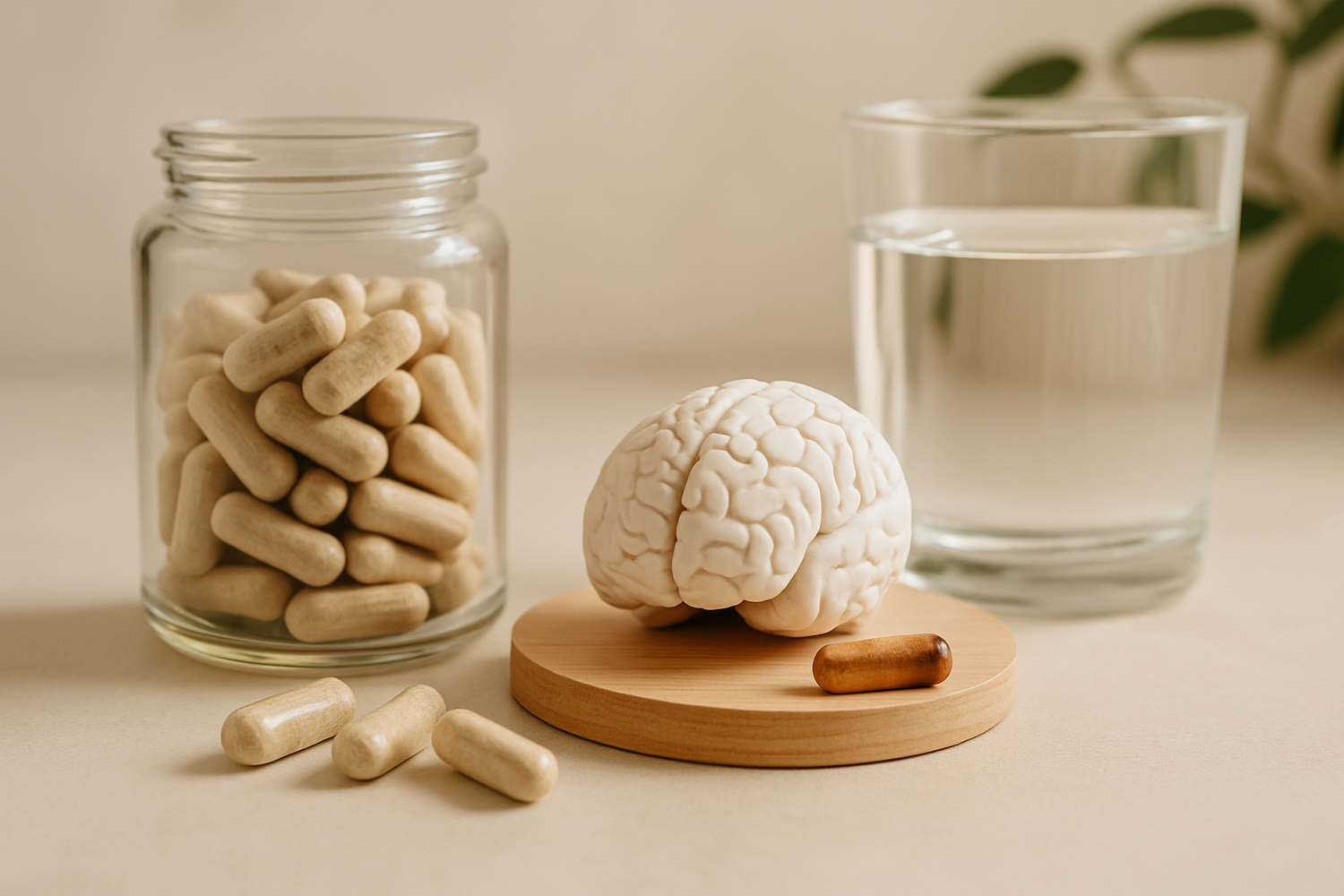
Most "best nootropic" lists rank ingredients by popularity or price. That tells you what's trendy — not what actually works. This article ranks six of the most common nootropic ingredients for focus by a single, transparent criterion: the number and quality of human clinical trials published as of 2026. If you're choosing a brain supplement and want to know which ingredients have real evidence behind them, this hierarchy will save you hours of research.
Whether you're a student revising for exams, a professional managing cognitive fatigue, or simply curious about nootropic supplements for focus, this guide is built for you. Each ingredient gets an evidence grade — Strong, Moderate, or Emerging — based on the trial data available.

How We Ranked These Nootropic Ingredients
We evaluated each ingredient against three criteria: (1) the number of randomised controlled trials (RCTs) specifically measuring attention or focus in healthy adults, (2) consistency of positive results across studies, and (3) whether trials used the ingredient in isolation or as part of a multi-ingredient blend. Ingredients tested alone score higher because we can attribute effects directly.
We drew from searches of PubMed, the Cochrane Library, and Examine.com's research database. Where meta-analyses exist, we prioritised those. Here's how the three evidence grades break down:
- Strong — 5+ RCTs with mostly consistent positive results in healthy adults
- Moderate — 3–5 RCTs with positive-to-mixed results
- Emerging — Fewer than 3 RCTs in healthy adults, or primarily animal/in-vitro data
1. Citicoline (CDP-Choline) — Evidence Grade: Strong
Citicoline may help support attention, processing speed, and mental energy by increasing brain levels of acetylcholine and phosphatidylcholine.* It is arguably the best-studied nootropic ingredient for cognitive focus in healthy populations.
A 2021 randomised, double-blind trial published in the Journal of Nutrition found that 500 mg of Cognizin® citicoline daily for 12 weeks significantly improved attentional performance in healthy adults compared to placebo [1]. An earlier 2015 study in Food and Nutrition Sciences showed similar attention improvements with 250 mg daily over 28 days [2].
Across more than 10 RCTs, citicoline consistently shows benefits for sustained attention — the kind you need during long work sessions or study blocks. It's also well-tolerated, with side-effect rates comparable to placebo in most trials.
Practical note: Effective doses in studies range from 250–500 mg/day. Citicoline is a key ingredient in Noobru Advantage, which delivers a clinically relevant dose in a single serving.*
2. L-Theanine — Evidence Grade: Strong
L-theanine, an amino acid found naturally in green tea, may help promote calm, focused attention without drowsiness.* It works by increasing alpha brain wave activity — the neural signature of relaxed concentration.
A 2019 randomised trial in Nutrients found that a single 200 mg dose of L-theanine improved reaction time and attention task accuracy within 60 minutes [3]. When combined with caffeine (a pairing studied extensively since 2008), L-theanine may help enhance focus and task-switching more than either compound alone [4].*
What makes L-theanine particularly useful is its speed. Unlike ingredients that take weeks to build up, a single dose can produce measurable effects. This makes it ideal for acute focus needs — a meeting, an exam, or a deadline sprint.
Practical note: Effective doses are 100–200 mg. L-theanine pairs exceptionally well with moderate caffeine (40–80 mg) for a focused-but-calm mental state. This is one of the most robust nootropic stacks in the literature.
3. Bacopa Monnieri — Evidence Grade: Moderate
Bacopa monnieri is an Ayurvedic herb that may help support memory consolidation and sustained attention over time.* Its mechanism involves modulating serotonin and acetylcholine activity in the hippocampus.
A 2014 meta-analysis of 9 RCTs, published in the Journal of Ethnopharmacology, concluded that Bacopa significantly improved attention and cognitive processing speed — but only after at least 4 weeks of supplementation [5]. A 2021 trial in Evidence-Based Complementary and Alternative Medicine reinforced this, finding attention improvements at the 8-week mark but not at 4 weeks [6].
The key caveat: Bacopa is a slow-builder. If you want focus help this afternoon, it won't deliver. But for long-term cognitive support, the evidence is solid.
Practical note: Study doses are typically 300–450 mg of standardised extract (with 50% bacosides). Take with food — Bacopa on an empty stomach can cause mild nausea in some people.

4. Rhodiola Rosea — Evidence Grade: Moderate
Rhodiola rosea is an adaptogen that may help reduce mental fatigue and support focus during stressful periods.* Rather than enhancing raw cognitive ability, Rhodiola appears to protect existing performance under stress.
A 2012 systematic review in BMC Complementary and Alternative Medicine found moderate evidence that Rhodiola improves cognitive function during fatigue and stress [7]. A more recent 2022 RCT involving medical residents showed improved attention scores during night shifts after 2 weeks of 400 mg daily supplementation.
The evidence is moderate because most trials study Rhodiola in fatigued or stressed populations rather than well-rested healthy adults. If your focus problems stem from burnout or sleep debt, Rhodiola may be more relevant than if you're simply optimising baseline performance.*
Practical note: Effective doses are 200–600 mg of standardised extract (3% rosavins, 1% salidroside). Best taken in the morning — it can be mildly stimulating.
5. Lion's Mane Mushroom — Evidence Grade: Emerging
Lion's mane (Hericium erinaceus) is a medicinal mushroom that may help support nerve growth factor (NGF) production, which is involved in neuroplasticity and long-term cognitive health.* It's one of the most exciting nootropic ingredients being researched in 2026.
A 2023 Australian RCT published in the Journal of Functional Foods found that 1.8 g of lion's mane extract daily for 28 days improved speed of performance on cognitive tasks — one of the first trials to demonstrate acute benefits in healthy young adults [8]. However, most existing evidence is from older adult populations or animal studies.
We grade lion's mane as "Emerging" because, despite strong mechanistic plausibility and promising early human data, fewer than five RCTs have been conducted in healthy working-age adults specifically measuring focus.
Practical note: Look for extracts standardised to hericenones and erinacines — these are the compounds thought to stimulate NGF. Dual-extracted products (hot water + ethanol) offer the broadest compound profile.
6. Ginkgo Biloba — Evidence Grade: Emerging (for Focus)
Ginkgo biloba is one of the most commercially popular brain supplements worldwide, but its evidence for focus specifically in healthy adults is surprisingly thin. Most positive trials involve older adults with cognitive decline or dementia.
A 2012 Cochrane review found that Ginkgo's effects on cognitive function in healthy people were "inconsistent and unreliable" [9]. A few smaller trials have shown modest improvements in working memory and processing speed, but these haven't been replicated consistently.
This doesn't mean Ginkgo is worthless — it may help support cerebral blood flow and has antioxidant properties.* But if your primary goal is sharper focus, the evidence points more strongly toward citicoline or L-theanine.
Practical note: If you choose Ginkgo, standardised extracts (24% flavone glycosides, 6% terpene lactones) at 120–240 mg daily are the most commonly studied doses.
Comparing Onset Speed and Evidence at a Glance
| Ingredient | Evidence Grade | Typical Onset | Study Dose Range |
|---|---|---|---|
| Citicoline | Strong | 2–4 weeks | 250–500 mg/day |
| L-Theanine | Strong | 30–60 minutes | 100–200 mg/dose |
| Bacopa monnieri | Moderate | 4–8 weeks | 300–450 mg/day |
| Rhodiola rosea | Moderate | 1–2 weeks | 200–600 mg/day |
| Lion's mane | Emerging | 4–8 weeks | 500–1800 mg/day |
| Ginkgo biloba | Emerging (for focus) | Variable | 120–240 mg/day |
Key Takeaways
- For the strongest evidence behind focus support, citicoline and L-theanine lead the field in 2026. Both have multiple high-quality RCTs in healthy adults.*
- For quick results, L-theanine (especially paired with caffeine) works within an hour. Most other nootropic ingredients need weeks of daily use.
- For long-term cognitive support, Bacopa monnieri and lion's mane are promising but require patience — budget at least 4–8 weeks.*
- Popularity ≠ evidence. Ginkgo biloba is a bestseller but has weaker focus-specific data than less hyped ingredients like citicoline.
- Stacking works. Combining ingredients with different mechanisms (e.g., citicoline for acetylcholine + L-theanine for alpha waves) may provide broader cognitive support than any single ingredient.*
Frequently Asked Questions
What is the best nootropic ingredient for focus?
Based on the volume and quality of human clinical trials, citicoline and L-theanine have the strongest evidence for supporting focus and concentration.* Citicoline has been studied in over 10 RCTs showing improvements in attention and processing speed.
Are nootropic supplements safe?
Most well-researched nootropic ingredients like L-theanine, citicoline, and Bacopa monnieri have strong safety profiles in clinical trials lasting up to 12 weeks. However, you should always consult your healthcare provider before starting any supplement, especially if you take medication.
How long do nootropic supplements take to work?
It depends entirely on the ingredient. L-theanine can produce calming focus within 30–60 minutes of a single dose. Bacopa monnieri and lion's mane typically require 4–8 weeks of daily use before cognitive benefits become noticeable.*
Can you stack multiple nootropic ingredients together?
Yes — and some combinations have their own clinical evidence. Combining L-theanine with caffeine is one of the most well-studied nootropic stacks, shown to improve attention and task-switching more than either ingredient alone [4].* Noobru Advantage uses a multi-ingredient approach based on this stacking principle.
What is the difference between natural and synthetic nootropics?
Natural nootropics include plant-derived compounds like Bacopa monnieri and lion's mane mushroom. Synthetic nootropics include lab-created compounds like noopept or racetams. All six ingredients in this article are naturally derived and available without prescription.
Try an Evidence-Based Nootropic Stack
If you'd rather not source and dose individual ingredients, Noobru Advantage combines several of the top-ranked ingredients from this list — including citicoline and L-theanine — in a convenient drinkable format designed to support focus and mental clarity.* Browse the full range at the Noobru shop.
References
- Nakazaki E, et al. "Citicoline and memory function in healthy older adults: a randomized, double-blind, placebo-controlled clinical trial." J Nutr. 2021;151(8):2153–2160. PubMed
- McGlade E, et al. "Improved attentional performance following citicoline administration in healthy adult women." Food Nutr Sci. 2012;3(6):769–773. DOI
- Hidese S, et al. "Effects of L-theanine administration on stress-related symptoms and cognitive functions in healthy adults." Nutrients. 2019;11(10):2362. PubMed
- Owen GN, et al. "The combined effects of L-theanine and caffeine on cognitive performance and mood." Nutr Neurosci. 2008;11(4):193–198. PubMed
- Kongkeaw C, et al. "Meta-analysis of randomized controlled trials on cognitive effects of Bacopa monnieri extract." J Ethnopharmacol. 2014;151(1):528–535. PubMed
- Sathyanarayanan V, et al. "Bacopa monnieri supplementation in healthy adults." Evid Based Complement Alternat Med. 2021. PubMed
- Hung SK, et al. "The effectiveness and efficacy of Rhodiola rosea L.: a systematic review of randomized clinical trials." Phytomedicine. 2011;18(4):235–244. PubMed
- Docherty S, et al. "The acute and chronic effects of lion's mane mushroom supplementation on cognitive function, stress and mood." Nutrients. 2023;15(22):4842. PubMed
- Laws KR, et al. "Is Ginkgo biloba a cognitive enhancer in healthy individuals? A meta-analysis." Hum Psychopharmacol. 2012;27(6):527–533. PubMed
*These statements have not been evaluated by the Food and Drug Administration or MHRA. This product is not intended to diagnose, treat, cure, or prevent any disease. Always consult your healthcare provider before starting any supplement regimen.


Leave a comment
All comments are moderated before being published.
This site is protected by hCaptcha and the hCaptcha Privacy Policy and Terms of Service apply.