




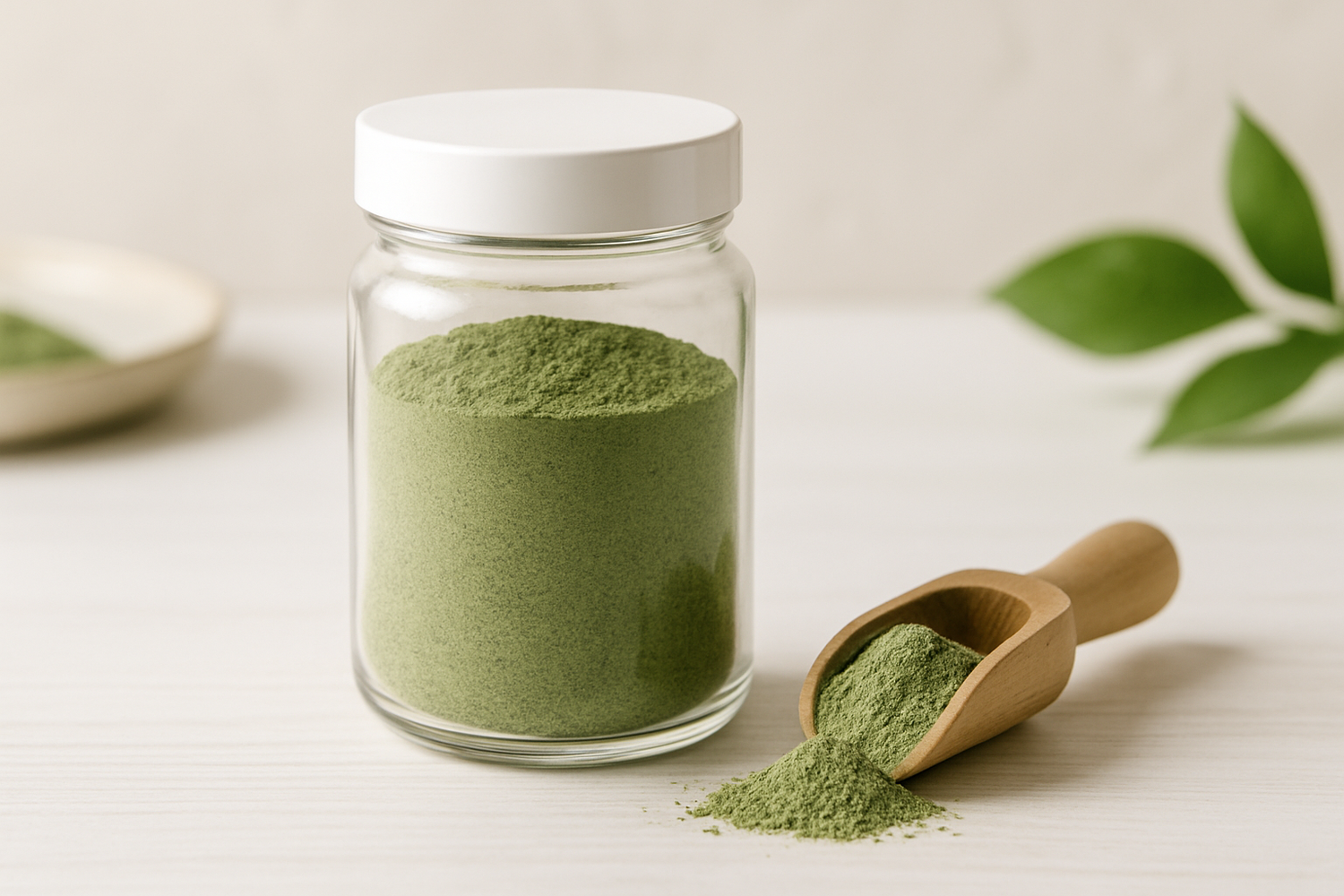
Most green powder supplement guides rank products by star ratings or taste. This article takes a different approach: it evaluates the eight most common ingredient categories found in greens powders by their actual clinical evidence, so you can judge any product's label for yourself — not just the ones a reviewer was paid to promote.
A green powder supplement is a concentrated blend of dried vegetables, fruits, algae, herbs, and extracts designed to be mixed into water or a smoothie. The UK market for these products has grown substantially in 2026, but the gap between marketing claims and clinical evidence remains wide. Below, we break down what the science supports, what it doesn't, and how to make a genuinely informed choice.
What Is a Green Powder Supplement, and Why Are They So Popular?
Green powder supplements — sometimes called super greens or superfood powders — typically combine 20 to 70 ingredients into a single scoop. The appeal is straightforward: busy adults who struggle to eat the NHS-recommended five portions of fruit and vegetables daily see these products as a convenient nutritional safety net.
According to the most recent Health Survey for England data, only around 28% of adults meet the five-a-day guideline. That gap drives demand. But convenience doesn't automatically equal efficacy.
The critical question isn't whether greens powders contain good ingredients — it's whether they contain them at meaningful doses. When a product crams 40+ ingredients into a 5–10g serving, the maths doesn't allow most individual compounds to reach clinically studied amounts.
A typical green drink powder might list spirulina, but include only 40–100mg — well below the 1–3g doses used in most research. Understanding this distinction is the single most useful skill you can develop as a supplement consumer.
The 8 Most Common Green Powder Ingredient Categories — Ranked by Evidence
Rather than evaluating brands, let's evaluate ingredients. Every greens powder on the market draws from roughly the same pool of compounds. Here's what the research actually shows for each category.
1. Vitamins C, D3, and B-Complex — Strong Evidence
These are the most reliably beneficial components in any greens powder. Vitamin C supports immune function* and its role in collagen synthesis and antioxidant defence is well established in peer-reviewed research (Carr & Maggini, 2017).
Vitamin D3 is particularly relevant in the UK, where the NHS recommends supplementation during autumn and winter months due to limited sunlight. B vitamins, including B6 and B12, are essential for neurotransmitter synthesis and may help support cognitive health* (Smith & Refsum, 2016).
The key advantage of vitamins is that their effective doses are small enough to fit into a greens powder format. A product delivering 1,000mg of vitamin C, for instance, is providing a clinically meaningful amount even within a compact serving size.
2. Ginger — Moderate to Strong Evidence
Ginger is a common addition to greens blends, and it's one of the better-supported ingredients. Research has explored its anti-inflammatory properties and its potential role in age-related neurological health* (Choi et al., 2018).
At doses of 100mg or more, ginger may help support digestive comfort and reduce markers of inflammation*. However, many greens powders include it at sub-clinical doses purely for flavouring — so always check the stated amount.
3. Green Tea Extract — Moderate Evidence
Rich in catechins (particularly EGCG), green tea extract has moderate evidence for antioxidant activity and metabolic support*. The typical studied dose is 200–500mg of standardised extract.
If your greens powder lists "green tea leaf" without specifying extract concentration, you likely aren't getting a meaningful catechin dose. Look for products that specify EGCG content in milligrams.
4. Spirulina (Green and Blue) — Moderate Evidence
Spirulina contains phycocyanin, a pigment with antioxidant and anti-inflammatory properties*. Blue spirulina specifically is concentrated for this compound. While the ingredient shows genuine promise, most clinical studies use doses of 1–3g daily.
That's far more than the 40–100mg found in a typical green powder supplement serving. At the doses commonly included, the practical benefit remains uncertain.
5. Echinacea and Elderberry — Moderate Evidence for Immunity
Both echinacea and elderberry are frequently added to greens powders marketed for immune support. Echinacea's fructans have demonstrated immunomodulatory and antiviral properties in laboratory research* (Dobrange et al., 2019), and elderberry is rich in anthocyanins with antioxidant effects*.
The challenge, again, is dose. Echinacea studies typically use 100–300mg of standardised extract, and elderberry research often employs 150–300mg. Check your label carefully.
6. Adaptogenic Herbs (Ashwagandha, Rhodiola, Panax Ginseng) — Strong Individual Evidence, Weak in Greens Blends
This is where the gap between ingredient evidence and product reality is most stark. Ashwagandha has strong clinical support for cortisol reduction at 300–600mg daily. Rhodiola Rosea has demonstrated significant reductions in mental fatigue at 200–600mg* (Ishaque et al., 2012). Panax ginseng may help reduce stress-related depression and anxiety* (Lee & Rhee, 2017).
However, when these adaptogens appear in a greens powder, they're almost always present at a fraction of their studied doses. A product listing "adaptogen blend 200mg" containing ashwagandha, rhodiola, and ginseng is giving you roughly 60–70mg of each — well below clinically relevant amounts.
7. Grass Powders (Wheatgrass, Barley Grass) — Weak Evidence
Wheatgrass and barley grass are among the most heavily marketed green powder ingredients, yet they have surprisingly thin clinical evidence. They contain chlorophyll, some vitamins, and minerals, but controlled studies demonstrating specific health benefits at typical supplemental doses are scarce.
Their inclusion is largely tradition-driven rather than evidence-driven.
8. Proprietary "Superfood Blends" — Insufficient Evidence to Evaluate
Many green powder supplements list a "proprietary superfood blend" without disclosing individual ingredient amounts. This practice — sometimes called "fairy dusting" — makes it impossible to assess whether any single ingredient is present at a useful dose.
Products that don't disclose individual amounts should be treated with scepticism regardless of their total ingredient count.
How to Evaluate Any Green Powder Supplement Label
Armed with the evidence above, here's a practical framework for assessing any greens product in 2026:
- Check for individual ingredient doses. If the label shows only a total blend weight (e.g., "Super Greens Blend 4,200mg") without breaking down each compound, you can't verify efficacy.
- Compare doses to clinical research. An ingredient is only as useful as its dose. 50mg of ashwagandha is not the same as 600mg, regardless of what the front label implies.
- Look for third-party testing. Reputable products will reference independent testing for purity and heavy metals — a genuine concern with algae and grass powders that concentrate soil contaminants.
- Be wary of ingredient count inflation. More ingredients doesn't mean a better product. A formula with 10 well-dosed compounds will outperform one with 50 ingredients at negligible amounts.
- Consider the format. Drinkable sachets with pre-measured, individually sealed doses offer better consistency than bulk tubs where settling can cause uneven ingredient distribution.
When a Targeted Supplement May Serve You Better
Green powder supplements try to do everything at once — immunity, energy, detox, cognitive support, and more. For some people, that broad approach provides a useful nutritional baseline. But for anyone with a specific health goal, a targeted formula with clinically dosed ingredients will almost always deliver more measurable results.
If your primary concern is immune resilience, for example, you need vitamin C at meaningful doses (around 1,000mg), along with compounds like elderberry, echinacea, and zinc at amounts the research actually supports.
If your focus is cognitive clarity, you need nootropic compounds like L-theanine, phosphatidylserine, and Alpha GPC at their studied doses — not trace amounts buried in a greens blend.
This is the fundamental trade-off: breadth versus depth. A green powder supplement offers breadth. A targeted, evidence-based supplement offers depth.
The Depth Approach in Practice: Transparent Dosing vs. Proprietary Blends
To illustrate the depth-over-breadth principle, it's worth looking at how targeted supplements handle the same ingredients that greens powders routinely under-dose.
Noobru Shield, for instance, delivers 1,000mg of vitamin C, 50mg of organic elderberry, 100mg of echinacea, and 100mg of organic ginger — each at or above the doses referenced in clinical research*. It also includes 100mg of organic Panax ginseng and immune-supporting zinc, all in a drinkable sachet format with every amount printed on the label.
For cognitive performance, Noobru Pro provides 200mg of Rhodiola Rosea — matching the dose used in published trials on mental fatigue* — alongside 500mg of Acetyl L-Carnitine and 150mg of Alpha GPC. Compare that to a typical greens blend where rhodiola appears as one line item inside a 200mg "adaptogen blend."
For memory and mental clarity, Noobru Advantage combines 200mg of L-theanine, 200mcg of Huperzine A, and 50mg of phosphatidylserine — compounds supported by research for cognitive maintenance*.
The point isn't that Noobru is the only option. It's that any supplement — greens powder or otherwise — should let you verify every dose on the label. Proprietary blends that hide individual amounts make this impossible.
Frequently Asked Questions
Are green powder supplements worth taking?
That depends entirely on the specific ingredients and doses. Some components like vitamin C and ginger have solid clinical backing, while others — particularly proprietary "superfood blends" — often lack evidence at the doses included. Always check the label for individual ingredient amounts rather than relying on total blend weight.
Can a green powder supplement replace fruits and vegetables?
No. Green powders lack the fibre, water content, and full phytonutrient diversity of whole produce. They may help fill specific micronutrient gaps*, but they should complement a balanced diet, not replace it.
What should I look for on a green powder supplement label?
Look for individually listed ingredient doses rather than proprietary blends, third-party testing, and clinically relevant amounts of each compound. If a product lists 30+ ingredients in a 5g serving, most are present at negligible doses.
When is the best time to take a greens powder?
Most people take them in the morning mixed into water or a smoothie. However, timing matters less than consistency. If a product contains caffeine or stimulants like green tea extract, avoid taking it in the evening.
Do greens powders help with immunity?
Some ingredients commonly found in greens powders — such as vitamin C, elderberry, and echinacea — have evidence supporting immune function*. However, the doses in many greens blends are far below clinically studied amounts, so the immune benefit of the overall product may be limited.
Key Takeaways
- A green powder supplement is only as effective as the doses of its individual ingredients — not the number of ingredients listed.
- Vitamins (C, D3, B-complex) and ginger are among the most reliably beneficial greens powder components because their effective doses fit the format.
- Adaptogens like ashwagandha and rhodiola have strong evidence individually, but are almost always under-dosed in greens blends.
- Proprietary blends that hide individual ingredient amounts make it impossible to assess a product's true value.
- For specific health goals — immunity, cognitive performance, energy — a targeted supplement with transparent dosing will typically outperform a broad greens powder.
Looking for evidence-based supplements with fully transparent ingredient doses — not a vague greens blend? Noobru offers targeted formulas for immunity, cognitive performance, energy, and more. Every ingredient and dose is listed on the label.
Try Noobru risk-free with our 90-day money-back guarantee →References
- Carr, A.C. & Maggini, S. (2017). Vitamin C and Immune Function. Nutrients, 9(11), 1211. PubMed 29099763
- Smith, A.D. & Refsum, H. (2016). Homocysteine, B Vitamins, and Cognitive Impairment. Annual Review of Nutrition, 36, 211–239. PubMed 22932777
- Dobrange, E. et al. (2019). Fructans as Immunomodulatory and Antiviral Agents: The Case of Echinacea. Biomolecules, 9(10), 615. PubMed 31126160
- Choi, J.G. et al. (2018). Pharmacotherapeutic potential of ginger and its compounds in age-related neurological disorders. Pharmacology & Therapeutics, 182, 56–69. PubMed 29370991
- Ishaque, S. et al. (2012). Rhodiola rosea for physical and mental fatigue: a systematic review. BMC Complementary and Alternative Medicine, 12, 70. PubMed 22643043
- Lee, S. & Rhee, D.K. (2017). Effects of ginseng on stress-related depression, anxiety, and the hypothalamic–pituitary–adrenal axis. Journal of Ginseng Research, 41(4), 589–594. PubMed 28219059
- NHS (2026). Vitamin D. nhs.uk
- NHS Digital. Health Survey for England. digital.nhs.uk
⚠️ Disclaimer: *These statements have not been evaluated by the Food and Drug Administration or MHRA. This product is not intended to diagnose, treat, cure, or prevent any disease. Always consult your healthcare provider before starting any supplement regimen.

Leave a comment
All comments are moderated before being published.
This site is protected by hCaptcha and the hCaptcha Privacy Policy and Terms of Service apply.