




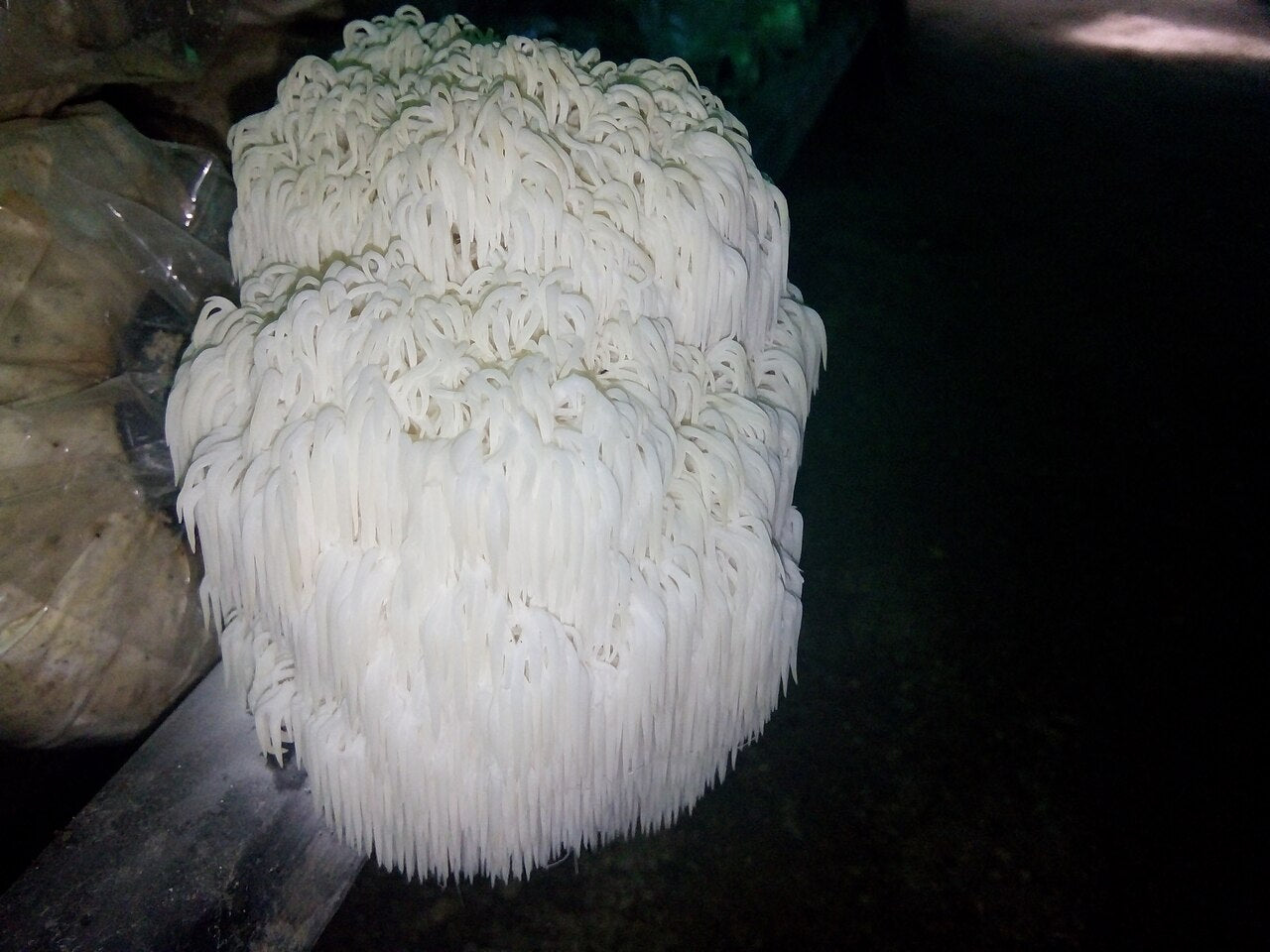
Most articles about lion's mane benefits recycle the same flat list — brain health, immunity, mood — without telling you which of those claims have survived testing in actual human beings and which are still extrapolated from mice or cell cultures. That distinction is everything. In this evidence review for 2026, we grade every commonly cited lion's mane benefit on a three-tier scale (Strong, Moderate, or Emerging) determined solely by whether it has supporting data from randomised human trials, observational human research, or only preclinical models.
Lion's mane (Hericium erinaceus) is an edible medicinal mushroom used in traditional Chinese and Japanese medicine for centuries. Its unique bioactive compounds — hericenones and erinacines — stimulate nerve growth factor (NGF) synthesis in ways no other widely available natural substance has been shown to replicate.
What Makes Lion's Mane Unique Among Nootropic Mushrooms?
Lion's mane is the only commonly available functional mushroom that contains two compound families — hericenones (in the fruiting body) and erinacines (in the mycelium) — capable of crossing the blood-brain barrier and promoting NGF synthesis. NGF is a protein essential for neuron survival, growth, and maintenance.
This mechanism is genuinely unusual. While other nootropics support neurotransmitter levels or cerebral blood flow, lion's mane is one of very few natural substances shown to promote structural neuronal growth — neurogenesis. A 2013 study in the International Journal of Medicinal Mushrooms confirmed that hericenones increased NGF synthesis in cultured astrocytes, consistent with earlier in-vitro findings (PubMed: 24266378).
This explains a practical quirk that frustrates new users: lion's mane cognitive benefits build gradually over weeks rather than delivering an immediate effect like caffeine or L-theanine.
Lion's Mane Benefits Graded by Strength of Evidence
The table below separates credible lions mane benefits from speculative ones. Each grade reflects whether the claim has human RCT support (Strong), limited human or robust animal data (Moderate), or only preclinical evidence (Emerging).
| Benefit | Evidence Grade | Study Type | Key Finding |
|---|---|---|---|
| Cognitive function in mild impairment | Strong | Human RCT | Significant improvement in cognitive scores after 16 weeks (Mori et al., 2009) |
| NGF stimulation | Strong | In-vitro + animal | Hericenones and erinacines reliably increase NGF across multiple independent labs |
| Anxiety and depression reduction | Moderate | Human trial | Reduced anxiety and irritability in menopausal women after 4 weeks (Nagano et al., 2010) |
| Neuroprotection | Moderate | Animal studies | Reduced amyloid-beta plaque formation and neuronal damage in mouse models |
| Gut health and immunity | Emerging | Animal + in-vitro | Prebiotic effects and immune cell modulation observed; no controlled human data yet |
| Anti-inflammatory effects | Emerging | Animal + in-vitro | Reduced TNF-alpha and IL-6 in multiple animal models; human trials pending |
Cognitive Function and Memory: The Strongest Human Evidence
The most robust evidence for lion's mane benefits comes from a 2009 double-blind, placebo-controlled trial by Mori et al. Thirty adults aged 50–80 with mild cognitive impairment received either 250mg lion's mane tablets three times daily (3,000mg total) or placebo for 16 weeks.
The lion's mane group scored significantly higher on cognitive function tests at weeks 8, 12, and 16. When supplementation stopped, scores declined within four weeks — suggesting ongoing use may be necessary to maintain benefits.* (PubMed: 18844328)
A 2020 pilot study from the University of Queensland added nuance. Healthy adults given lion's mane extract standardised for hericenones showed improvements in recognition memory after just 28 days, with faster performance on complex cognitive tasks. The sample was small, but it expanded the potential audience beyond people with existing impairment.*
One important gap the Mori study left open: the participants had pre-existing mild cognitive impairment. Whether lion's mane produces equivalent benefits in cognitively healthy adults under 50 remains an open question — though the Queensland data is encouraging.
Nerve Growth and Neuroprotection: Why Researchers Are Excited
Lion's mane's NGF-stimulating properties have been confirmed across dozens of independent laboratory and animal studies since Dr Hirokazu Kawagishi first identified the mechanism in 1994.
A 2016 animal study found that lion's mane extract reduced cognitive decline and neuronal damage in mice with induced Alzheimer's-like conditions, lowering amyloid-beta plaque accumulation. At least three registered clinical trials are now investigating lion's mane in early-stage cognitive decline, with results expected in 2026 and 2027. The Alzheimer's Research UK website tracks several of these ongoing studies.
Honesty about limitations matters here: no human study has demonstrated that lion's mane can prevent or reverse neurodegenerative disease. The evidence suggests its NGF-stimulating compounds may help support healthy neuronal maintenance and repair — a meaningful but narrower claim.*
Anxiety, Mood, and Stress: A Promising Secondary Benefit
A 2010 study by Nagano and colleagues gave 30 menopausal women either lion's mane cookies (2,000mg fruiting body powder daily) or placebo for four weeks. The lion's mane group reported significantly reduced anxiety, irritability, and difficulty concentrating compared to placebo.* (PubMed: 20834180)
The proposed mechanism: lion's mane–driven NGF production may indirectly support mood by promoting hippocampal neurogenesis, a process impaired in depression and chronic stress. This aligns with broader neuroscience research linking neuroplasticity to emotional resilience.
However, the anxiety evidence for lion's mane is thinner than for dedicated adaptogens. Ashwagandha, for instance, has multiple larger RCTs showing significant cortisol and stress score reductions. If anxiety is your primary concern rather than cognition, the evidence currently favours adaptogens — though lion's mane may offer complementary mood support alongside its primary cognitive effects.*
Gut Health, Immunity, and Inflammation: What We Know So Far
Lion's mane contains polysaccharides — particularly beta-glucans — with demonstrated prebiotic and immune-modulating properties in laboratory settings. A 2017 study found that lion's mane polysaccharides promoted beneficial gut bacteria growth and enhanced intestinal immune cell activity in mice.
Anti-inflammatory effects have appeared in multiple animal models, with lion's mane extracts reducing markers like TNF-alpha and IL-6. However, these findings remain preclinical. It would be premature to choose lion's mane primarily for gut health or immunity based on current evidence.
For immune support specifically, nutrients like vitamin C and compounds like elderberry have a substantially stronger human evidence base. The NHS vitamin C guidelines provide a useful overview of established immune-related evidence.
How to Choose a Quality Lion's Mane Supplement in 2026
The lion's mane market is crowded and product quality varies enormously. Five criteria separate effective products from expensive placebos:
- Extraction method: Dual-extraction products (hot water + ethanol) capture both water-soluble beta-glucans and alcohol-soluble hericenones/erinacines. Single-extraction products miss half the bioactives.
- Fruiting body vs. mycelium: Fruiting body extracts contain hericenones; mycelium contains erinacines. Products including both — or at minimum the fruiting body — are preferable.
- Standardisation: Look for products standardised for beta-glucan content (≥30%) and/or hericenone content. Unstandardised products deliver unpredictable doses.
- Dose: Human studies used 500mg–3,000mg daily. Standardised extracts may be effective at lower doses; whole-mushroom powders typically need higher amounts.
- Third-party testing: Some products contain grain starch from the growing substrate. Transparent labelling and independent testing certificates (e.g., from the MHRA-compliant labs) indicate a trustworthy product.
Where Lion's Mane Fits in a Broader Cognitive Support Strategy
Lion's mane targets one specific mechanism — NGF-driven neuronal growth and maintenance. That mechanism is powerful but narrow. Cognitive performance in daily life depends on multiple systems working together: neurotransmitter availability, stress resilience, cellular energy production, and neuroprotection.
This is the logic behind multi-pathway nootropic formulations. For example, Noobru Advantage pairs phosphatidylserine (50mg, supporting neuronal membrane integrity*) with huperzine A (200mcg, supporting acetylcholine levels linked to learning and recall*) and L-theanine (200mg, promoting alpha brain wave activity for calm focus*).
None of these compounds do what lion's mane does — stimulate NGF — and lion's mane doesn't do what they do. They're complementary rather than competing.
If you're already taking lion's mane for long-term neuronal support, a multi-ingredient cognitive formula can address the faster-acting pathways (neurotransmitter support, stress adaptation) that lion's mane doesn't cover. This kind of layered approach is increasingly discussed in neuroscience literature on cognitive optimisation.
Frequently Asked Questions
How long does it take for lion's mane to work?
Most human studies showing cognitive benefits used supplementation periods of 8–16 weeks. Some people report improvements in focus and mental clarity within 2–4 weeks, but measurable changes in nerve growth factor levels typically require consistent use over several months.
Can you take lion's mane every day?
Yes, daily supplementation appears safe based on available clinical trials. Studies using doses of 500mg–3,000mg daily for up to 16 weeks reported no significant adverse effects. As with any supplement, consult your healthcare provider before starting a new regimen.
Does lion's mane actually improve memory?
A 2009 Japanese randomised controlled trial found that adults aged 50–80 with mild cognitive impairment scored significantly higher on cognitive function tests after 16 weeks of lion's mane supplementation compared to placebo. However, scores declined when supplementation stopped, suggesting ongoing use may be needed.*
Is lion's mane better as a powder or extract?
Extracts standardised for hericenones and erinacines are generally preferred because these are the active compounds linked to nerve growth factor stimulation. Whole-mushroom powders contain them at lower, more variable concentrations. Look for dual-extraction products for the broadest spectrum of bioactives.
Are there any side effects of lion's mane?
Lion's mane is generally well tolerated. Rarely reported side effects include mild digestive discomfort, skin rash, or itching — typically in individuals with mushroom allergies. People on anticoagulant or antiplatelet medications should consult their doctor, as lion's mane may have mild blood-thinning properties.
Key Takeaways
- Lion's mane is one of the few natural compounds shown to stimulate nerve growth factor production, making it uniquely valuable for long-term brain health support.*
- The strongest human evidence supports cognitive benefits in mild impairment, with a 16-week RCT showing significant improvements in cognitive function scores.*
- Mood and anxiety benefits are promising but less robust, supported by one human trial showing reduced anxiety in menopausal women after four weeks.*
- Gut health and anti-inflammatory claims remain preclinical — interesting in animal models, unproven in humans.
- Quality varies enormously: choose dual-extracted, fruiting-body products standardised for beta-glucans or hericenones, dosed at 500mg–3,000mg daily.
- Lion's mane works through one mechanism; pairing it with compounds that target neurotransmitters, stress adaptation, and cellular energy covers the pathways it doesn't.
Looking for evidence-based cognitive support that complements lion's mane through different pathways? Noobru Advantage delivers clinically studied doses of phosphatidylserine, huperzine A, and L-theanine in a single drinkable sachet — targeting neurotransmitter support, focus, and neuroprotection.*
Explore Noobru's full range with a 90-day money-back guarantee →References
- Mori K, Inatomi S, Ouchi K, Azumi Y, Tuchida T. Improving effects of the mushroom Yamabushitake (Hericium erinaceus) on mild cognitive impairment: a double-blind placebo-controlled clinical trial. Phytotherapy Research. 2009;23(3):367–372. PubMed: 18844328
- Nagano M, Shimizu K, Kondo R, et al. Reduction of depression and anxiety by 4 weeks Hericium erinaceus intake. Biomedical Research. 2010;31(4):231–237. PubMed: 20834180
- Lai PL, Naidu M, Sabaratnam V, et al. Neurotrophic properties of the Lion's mane medicinal mushroom, Hericium erinaceus (Higher Basidiomycetes) from Malaysia. International Journal of Medicinal Mushrooms. 2013;15(6):539–554. PubMed: 24266378
- Chong PS, Fung ML, Wong KH, Lim LW. Therapeutic Potential of Hericium erinaceus for Depressive Disorder. International Journal of Molecular Sciences. 2020;21(1):163. PubMed: 31881712
- Saitsu Y, Nishide A, Kikushima K, Shimizu K, Ohnuki K. Improvement of cognitive functions by oral intake of Hericium erinaceus. Biomedical Research. 2019;40(4):125–131. PubMed: 31413233
*These statements have not been evaluated by the Food and Drug Administration or MHRA. This product is not intended to diagnose, treat, cure, or prevent any disease. Always consult your healthcare provider before starting any supplement regimen.


Leave a comment
All comments are moderated before being published.
This site is protected by hCaptcha and the hCaptcha Privacy Policy and Terms of Service apply.